
AI Agents: What They Are and Where They Actually Work
An operator-focused guide on when AI agents succeed, the workflows they reliably improve, and how to build production-ready agent systems.
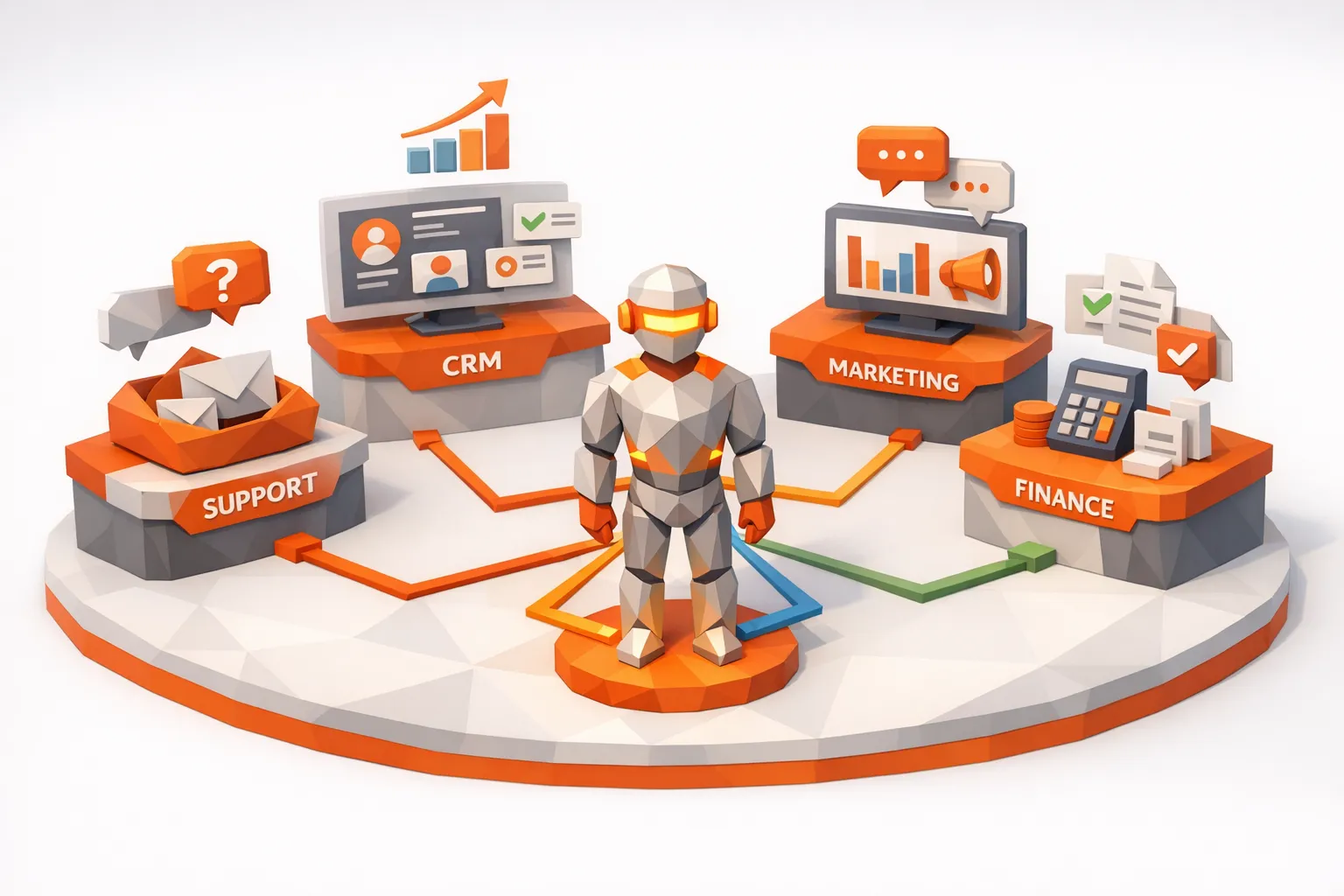
Most “AI agent” demos look magical: you give a goal, it clicks around, writes things, and comes back with an answer. In production, the reality is simpler and more useful.
AI agents work best when they are tightly scoped, tool-connected, and measured against a real outcome. When teams treat agents like autonomous employees, they usually get brittle workflows, inconsistent quality, and unexpected risk.
This guide explains what AI agents are (in operator terms), how they differ from chatbots and automation, and the specific places they reliably deliver ROI in 2026.
What is an AI agent (a practical definition)
An AI agent is software that uses an AI model (often an LLM) to decide and take actions toward a goal, usually by calling tools (APIs), following rules, and updating its next step based on what happened.
The key difference from “chat” is that an agent is built around an execution loop:
Sense: gather context (a ticket, a thread, CRM fields, logs, documents).
Decide: choose the next action (classify, ask a question, draft, route, call an API).
Act: use a tool (search, write to a database, create a task, send a message).
Observe: check results (tool output, errors, user response, conversion events).
Iterate: repeat until a stop condition is met.
If the system is not reliably taking actions (or producing artifacts that cause actions), it is usually just an assistant, not an agent.
Chatbot vs automation vs agent
A useful way to separate hype from reality is to look at where decisions come from.
| System | What it’s good at | Where it breaks | Typical examples |
|---|---|---|---|
| Chatbot / copilot | Explain, summarize, draft, answer questions | Not grounded, no accountability to outcomes | “Summarize this doc”, “Draft a reply” |
| Rule-based automation | Repeatable steps with deterministic inputs | Falls apart when inputs are messy or ambiguous | Zapier-style workflows, routing rules |
| AI agent | Messy inputs + tool use + iterative decisions | Unclear goals, unsafe permissions, weak evaluation | Triage agents, research agents, engagement agents |
Agents shine when inputs are fuzzy (human language, mixed context) but outputs must land in a structured system (CRM, ticketing, queue, pipeline).
What people usually mean by “AI agents”
Most business use cases fall into four practical categories.
| Agent type | What it actually does | “Where it works” signal | Main risk |
|---|---|---|---|
| Triage and routing agents | Classify, score priority, choose an owner, create tasks | You can measure precision and speed | Misclassification causes missed revenue or escalations |
| Drafting agents | Produce first drafts tied to context (responses, briefs, notes) | Humans regularly accept with light edits | Hallucinated specifics, wrong tone |
| Tool-runner agents | Execute bounded actions via APIs (create tickets, enrich leads, update fields) | Actions are reversible and logged | Over-permissioning, runaway actions |
| Multi-step research agents | Search, read, extract, compare, write a recommendation | Clear “done” format and citations | Source quality and brittle browsing |
If you are starting from zero, triage + drafting are the fastest paths to something that works consistently.
Where AI agents actually work (and why)
Below are the environments where agents tend to perform well because the workflow has three properties: clear inputs, a bounded action space, and observable success metrics.
1) Customer support: ticket triage, response drafting, and escalation
Support is one of the highest-ROI places for agentic systems because the work is repetitive, text-heavy, and already measured.
Where agents work:
Auto-labeling and routing (billing, bug, feature request, urgent, VIP).
Drafting replies from known sources (help center, past resolutions, policies).
Summarizing long threads for a human owner.
Why it works: tickets have clear artifacts (category, SLA, CSAT), and actions are easy to audit.
Success metrics: time to first response, resolution time, deflection rate, escalation rate, CSAT.
2) Sales and revenue ops: lead enrichment and “next best action”
Agents can reliably convert messy, unstructured inputs into structured CRM updates.
Where agents work:
Enrich a lead (company description, ICP fit notes) from approved sources.
Write a first-touch email draft using product positioning and lead context.
Route inbound requests to the right motion (self-serve vs sales-led).
Why it works: you can constrain the output schema (fields) and add a human gate before sending anything externally.
Success metrics: speed to qualified lead, meeting booked rate, reply rate (if outbound), pipeline per rep hour.
3) Marketing ops: capture existing demand in public conversations
This is the “agents are surprisingly good” category when you focus on demand capture, not broad brand building.
Where agents work:
Continuous monitoring for high-intent language.
Classifying intent and fit, then queuing opportunities.
Drafting context-aware replies that a human can approve (or that autopost within strict constraints).
Reddit is a strong example because conversations are explicit and often purchase-adjacent. Purpose-built systems can outperform general agents by narrowing the job: find relevant threads, extract context, draft an on-native response, and measure outcomes.
Success metrics: time-to-thread, reply rate, click-through rate, assisted conversions, cost per qualified conversation.
4) Data and analytics: question-to-query-to-decision workflows
Agents work when they are not “doing analytics” in the abstract, but instead translating questions into concrete queries and explanations.
Where agents work:
Convert stakeholder questions into SQL, run it, summarize results.
Monitor dashboards and create “why did this move?” investigation tasks.
Generate weekly narrative reports from a known metric set.
Why it works: the tool surface (database, BI API) is clear, and the output can be validated.
Success metrics: analyst time saved, accuracy of generated queries, decision cycle time.
5) Engineering operations: narrow, reviewable automation
In software teams, agents are most reliable when outputs are reviewable artifacts.
Where agents work:
Draft pull request descriptions, change logs, and release notes.
Triage bug reports (dedupe, repro steps extraction).
Suggest code changes in small, bounded areas with tests.
Why it works: version control provides an audit trail, and humans already review changes.
Success metrics: cycle time, review burden, bug triage throughput.
6) Finance ops: categorization, document extraction, and exceptions
Finance is a good fit because the workflows are structured, and mistakes can be caught with rules.
Where agents work:
Extract fields from invoices and receipts.
Categorize transactions with confidence thresholds.
Flag anomalies and create an “exceptions” queue.
Success metrics: % auto-processed, exception rate, close time.
7) IT and security: alert triage and playbook execution
Agents can reduce noise and speed up response when they operate inside playbooks.
Where agents work:
Summarize alerts and attach likely causes.
Correlate logs across tools and propose next steps.
Execute low-risk steps (disable a token, open a ticket) with approvals.
Success metrics: mean time to acknowledge (MTTA), mean time to resolve (MTTR), false positive reduction.
The agent “works in production” checklist
Most agent failures are not model failures. They are product and operations failures: unclear goals, weak tool boundaries, and no evaluation.
A production-ready agent usually has these properties:
| Requirement | What “good” looks like | What “bad” looks like |
|---|---|---|
| A narrow unit of work | “Classify threads by intent and draft a reply” | “Run my marketing” |
| Bounded actions | Few tools, limited permissions, reversible actions | Full access to email, payments, admin panels |
| Grounding | Pulls from approved sources, includes citations when needed | Makes claims from memory |
| Stop conditions | Clear done criteria and timeouts | Infinite loops and “keep trying” |
| Human gates where it matters | Review required for risky outputs | Autonomous posting/sending everywhere |
| Measurement | Logged outcomes tied to the unit of work | Vibes-based success |
For risk and governance language, the NIST AI Risk Management Framework is a solid baseline for thinking about safety, accountability, and monitoring without getting stuck in theory.
Common failure modes (and what they imply)
When teams say “agents don’t work,” it often means one of these:
Hallucinated details
The agent fills in specifics it does not know (pricing, policies, product behavior). This is a grounding and evaluation problem.
Fix: force retrieval from approved sources, constrain outputs to what can be supported, and require uncertainty language when confidence is low.
Tool errors that look like “reasoning” errors
APIs fail, rate limits hit, a page changes, or permissions are wrong.
Fix: better retries, better tool error handling, fallbacks, and tool-specific evals.
Over-automation in reputation-sensitive channels
Agents can draft, but fully autonomous external communication can create brand risk.
Fix: split into stages (discover, score, draft, queue), then automate only what you can measure and safely reverse.
Prompt injection and untrusted inputs
If an agent reads the open web or user content, it can be manipulated into taking unintended actions.
Fix: treat external text as untrusted, isolate tool permissions, and validate actions against policy.
(If you want a deeper marketing-first breakdown of agent loops and failure modes, Redditor AI has a strong explainer in Clawdbot Explained: Can AI Agents Actually Run Your Marketing?.)
A simple framework: should this be an agent at all?
Before building, ask two questions:
Is there a repeated decision under ambiguity? If the decision is deterministic, automation wins.
Can you measure success at the unit-of-work level? If you cannot measure it, you cannot improve it.
Here is a quick decision table:
| If your workflow is… | Best starting point |
|---|---|
| Deterministic steps, clean inputs | Rule automation (no agent) |
| Messy inputs, but output is a draft | Copilot or drafting agent |
| Messy inputs, output is a routing decision | Triage agent |
| Messy inputs, requires tool use, but actions are reversible | Tool-runner agent with strict permissions |
| Vague goals, unclear outputs, hard to measure | Do not build an agent yet |
How to implement your first AI agent (without getting stuck in demos)
Pick one unit of work that already has a queue
Agents become real when they attach to an operational system: support queue, CRM, backlog, moderation queue, inbox.
Good examples:
“Every inbound lead gets enriched and scored within 10 minutes.”
“Every high-intent Reddit thread gets a drafted reply within 30 minutes.”
Define success metrics before prompts
Prompts are not strategy. Define what “better” means.
Examples:
Precision and recall for triage (are we catching the right items?).
Time to first action (speed is often the main ROI lever).
Conversion per handled item (reply-to-click, click-to-signup, ticket-to-resolution).
Constrain the agent’s world
The fastest way to make an agent reliable is to reduce what it can do.
Limit tools to the minimum set.
Use schemas for outputs (fields, categories, confidence).
Add explicit stop conditions (max steps, max tool calls, timeout).
If you want a well-known research pattern for tool-using reasoning, the ReAct approach is a common reference point (reasoning + acting in a loop). The original paper is here: ReAct: Synergizing Reasoning and Acting in Language Models.
Add evaluation and logging from day one
You do not need a massive eval harness to start, but you do need:
A labeled sample set (even 50 to 200 items)
A way to replay runs
A way to review failures and update constraints
This is how agent systems compound. Without it, they stay as demos.
Where purpose-built agents beat general agents (a Reddit example)
General agents can browse Reddit, but teams usually do not need a general agent. They need a repeatable customer acquisition workflow.
A practical “agentic” Reddit motion looks like this:
Monitor for relevant conversations (category, competitor, problem language)
Classify intent and fit
Extract the key context (what they tried, constraints, what “good” means)
Draft a helpful, native reply with an optional soft CTA
Track the outcome thread-by-thread
That is exactly where a specialized product can outperform DIY:
Fewer tools, fewer permissions, fewer edge cases
A workflow designed around measurable outcomes
If your goal is Reddit-driven demand capture, Redditor AI is positioned as a purpose-built way to do this with:
AI-driven Reddit monitoring
URL-based setup
Finding relevant conversations
Automatic brand promotion
Customer acquisition automation
You can also compare the larger operational approach in their guide to Reddit automation, which focuses on turning discovery and engagement into measurable pipeline.
The bottom line
AI agents are not a single technology, they are a product pattern: LLM-driven decisions + tools + constraints + measurement.
They work best when:
The job is narrow and repeated
The action space is bounded
Outputs are reviewable or reversible
Success is measured per unit of work
If you pick the right slice, agents stop being hype and start being infrastructure: they turn messy, high-signal inputs into consistent actions that move metrics.

Thomas Sobrecases is the Co-Founder of Redditor AI. He's spent the last 1.5 years mastering Reddit as a growth channel, helping brands scale to six figures through strategic community engagement.