
AI Automation: The Minimum Stack to Save 10 Hours a Week
A practical six-component stack and 7-day rollout to automate repetitive work, speed responses, and reclaim ten hours a week.
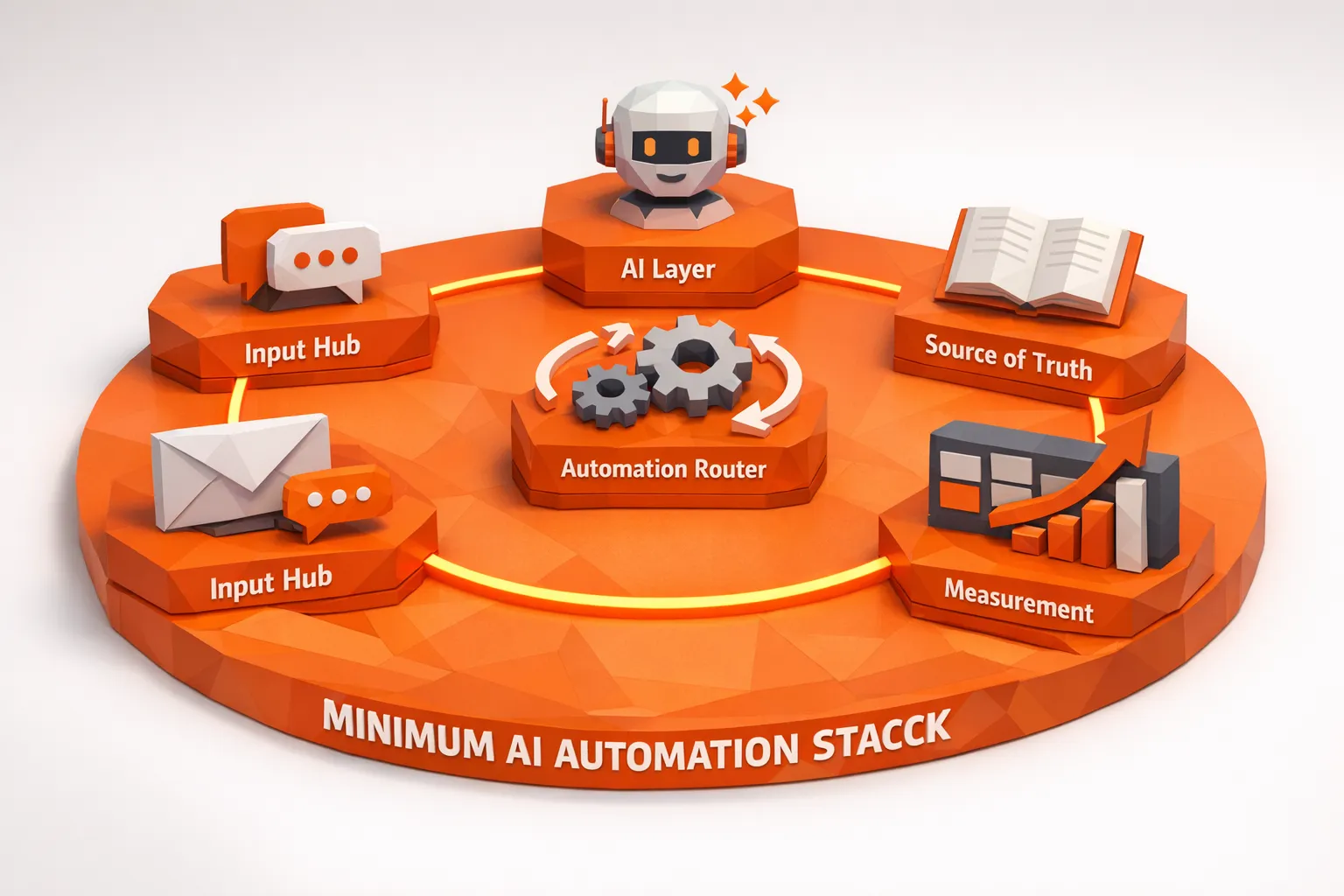
Most teams do not need a complex “agent architecture” to get real leverage from AI automation. They need a minimum stack that reliably handles repetitive work, routes edge cases to a human, and produces outputs that ship.
If your goal is to save 10 hours a week, the fastest path is not “automate everything.” It is to automate a small set of high-frequency, low-creativity tasks that happen every day: capturing requests, summarizing context, drafting first passes, and moving work forward.
Below is the minimum AI automation stack that works for founders, growth marketers, and small teams, plus a simple rollout plan you can implement in a week.
What “AI automation” means (in practice)
AI automation is best thought of as a pipeline:
Sense: collect signals (requests, leads, issues) from where they happen.
Decide: classify and prioritize (what matters now, what can wait, what is spam).
Act: draft, route, update systems, or trigger workflows.
Learn: measure outcomes and improve prompts, rules, and destinations.
This framing keeps your system grounded in operations, not demos. If you want a deeper operator-level breakdown, Redditor AI also has a plain-English explainer on how AI systems behave in real workflows: AI: How It Works (In Plain English for Operators).
The minimum stack: 6 components (and why you need each)
You can save 10 hours a week with six building blocks. Everything else is optional.
1) An input hub (where work enters)
Pick one place where requests and signals land, otherwise automation becomes chaos.
Common choices:
A shared email inbox (support@, partnerships@)
A Slack channel (for internal requests)
A form (for leads, bug reports, requests)
A monitored public surface (Reddit, X, review sites)
The key is not the tool, it is the rule: if it is not in the hub, it does not exist.
2) An automation router (triggers and actions)
You need something that connects apps and runs “if this, then that” workflows.
Good fits include:
Zapier or Make (fastest to launch)
n8n (more control, self-hosting optional)
This router should handle simple mechanics: create tasks, post to Slack, enrich a row, write to a CRM field.
3) An AI layer (for classification and drafting)
Use an LLM where it has clear ROI:
Summarize long context into a short brief
Classify intent (support, sales, spam, urgent)
Draft a first-pass response in your voice
Extract structured fields (company, pain, competitor, timeline)
This can be done via ChatGPT/Claude for manual workflows, or an API inside your router for fully automated steps.
If you want to keep outputs trustworthy, treat AI as a junior operator: it drafts and extracts, a human approves where risk is high.
4) A “source of truth” (knowledge and reusable components)
Automation fails when every output starts from scratch.
Create a lightweight library in Notion/Google Docs:
Your product one-liners (different angles)
Common objections and your best answers
Proof snippets (results, screenshots, benchmarks you can stand behind)
Response components (openers, clarifiers, next steps)
This is what makes outputs consistent and fast.
5) A work queue (so automation becomes throughput)
Even if AI drafts everything, humans still need a place to review and ship. Use:
Linear/Jira (engineering)
Trello/Asana (ops and marketing)
A simple “reply queue” in a spreadsheet
Your queue is where tasks get an owner, SLA, and outcome.
6) Measurement (time saved is nice, revenue is better)
If you only track activity, you will automate the wrong things.
Minimum measurement:
Volume: items processed per week
Cycle time: time-to-first-response, time-to-resolution
Outcome: conversions, booked calls, churn prevented, pipeline influenced
For lead workflows specifically, add attribution early. If you are doing Reddit-based acquisition, this guide is the practical version: Reddit Lead Attribution: Track From Thread to Sale.
The minimum AI automation stack (one-table version)
Use this table as your buying and setup checklist.
| Layer | What it does | Minimum requirement | Common options |
|---|---|---|---|
| Input hub | Centralizes requests and signals | One place everyone uses | Gmail/Helpdesk inbox, Slack channel, Typeform, Reddit monitoring |
| Automation router | Triggers workflows across tools | Reliable triggers + logs | Zapier, Make, n8n |
| AI layer | Summarizes, classifies, drafts, extracts | Structured outputs (JSON or fields) | ChatGPT/Claude (manual), API calls inside workflows |
| Source of truth | Prevents “blank page” drafting | Reusable snippets and policies | Notion, Google Docs |
| Work queue | Turns automation into throughput | Owners + priorities + SLA | Trello, Asana, Linear, Jira |
| Measurement | Proves ROI and guides iteration | Outcomes, not vanity | GA4, CRM fields, simple spreadsheet scorecard |
Where the “10 hours a week” usually comes from
In most teams, time leakage clusters in a few buckets:
Reading and summarizing long threads, tickets, and conversations
Context switching (finding links, reconstructing what happened)
First drafts (emails, replies, follow-ups, internal updates)
Manual routing (forwarding, tagging, assigning)
Generative AI is particularly strong at compressing information and producing first passes. McKinsey’s research on generative AI highlights that it can automate or accelerate a meaningful share of knowledge work tasks, especially text-heavy activities like drafting and summarization (McKinsey, The economic potential of generative AI). You do not need the macro numbers to benefit from the micro reality.
A 7-day rollout plan (designed for small teams)
The goal is speed to value, not perfection.
Day 1: Pick two workflows (not ten)
Choose workflows that are:
High frequency (daily or near-daily)
Low ambiguity (clear “done” state)
Measurable (time-to-response, conversion, resolution)
Examples that work across most companies:
Support intake triage and reply drafting
Sales lead intake enrichment and follow-up drafting
Public conversation monitoring and response drafting (Reddit is a common high-intent surface)
Day 2: Define “inputs” and “outputs” in one page
For each workflow, write:
Input source (where it comes from)
Required fields (what must be extracted)
Output destination (where it should land)
Owner and SLA
Success metric
If you cannot define these, do not automate it yet.
Day 3: Build the router (trigger, transform, deliver)
Keep it boring:
Trigger: new email, new form submission, new mention, new thread
Transform: summarize + classify + extract fields
Deliver: post to Slack, create a task, write to CRM
Day 4: Add guardrails (so it does not embarrass you)
Minimum guardrails that are worth implementing:
A “do not answer” list (regulated topics, medical/legal advice, sensitive categories)
A confidence threshold (low confidence routes to human)
A link policy (when to include a link, when to omit)
This is not about being overly cautious. It is about preventing rework, which kills your time savings.
Day 5: Create a tiny component library
Create 10 reusable blocks:
3 openers (friendly, direct, technical)
3 clarifying question sets
2 proof snippets you can stand behind
2 soft CTAs (low friction)
You will be shocked how much faster your system gets when drafting is “assembly,” not writing.
Day 6: Run a controlled pilot
Pilot rules that keep things clean:
Limit volume (only P1 or high-priority items)
Review everything before shipping
Track outcomes in a simple scorecard
Day 7: Promote what worked into default behavior
Turn the pilot into a routine:
Daily: check the queue, approve drafts, log outcomes
Weekly: update component library, adjust classification rules
The “minimum stack” workflows that consistently pay off
Below are three workflows that most teams can implement quickly. You only need two to hit the 10-hour target, but the third is often the revenue multiplier.
| Workflow | What gets automated | Typical human role | Best success metric |
|---|---|---|---|
| Support triage + draft | Summaries, categorization, suggested replies | Approve and personalize, handle edge cases | Time-to-first-response, resolution time |
| Lead intake enrichment | Extract firmographics, pain, source, next step | Qualify and follow up | Lead-to-meeting rate, speed-to-lead |
| High-intent conversation capture (Reddit) | Monitoring, prioritization, first-pass replies | Add credibility, choose CTA, measure | Reply-to-click, click-to-signup/demo |
Why Reddit is often the easiest “revenue automation” win
Most marketing automation starts with outbound volume. Reddit is different: it often starts with existing demand. People are already asking for tool recommendations, alternatives, comparisons, and “what would you do?” advice.
The problem is operational, not strategic:
The best threads appear continuously.
Timing matters (early replies get read).
Manual monitoring does not scale.
That is where tools built specifically for this workflow fit.
Where Redditor AI fits in the minimum stack
If Reddit is part of your go-to-market, Redditor AI can replace a messy combo of manual searching, spreadsheets, and inconsistent follow-ups.
Based on the product summary you provided, Redditor AI is designed to:
Monitor Reddit with AI to find relevant conversations
Automatically promote your brand in those conversations
Start with URL-based setup, so you can get to first value quickly
A practical way to use it inside the stack above:
Input hub: Reddit conversations
AI layer: relevance detection and draft promotion
Work queue: review and approve (if you want human-in-the-loop)
Measurement: track which threads drove clicks and customers
If you want the broader conceptual map (what to automate vs keep human), this article complements the stack: Everything You Need To Know About Reddit Automation.
Common mistakes that erase your time savings
Automating before you standardize
If humans are inconsistent, automation just accelerates inconsistency. Write the one-page workflow first.
Chasing “fully autonomous” instead of “high throughput”
A system that drafts 80 percent and routes 20 percent to a human is usually better than a system that tries to ship 100 percent automatically and causes cleanup work.
Measuring activity, not outcomes
If you measure “number of automations,” you will build busywork. If you measure cycle time and conversions, the system improves naturally.
Frequently Asked Questions
What is the minimum AI automation stack? The minimum AI automation stack is an input hub, an automation router (Zapier/Make/n8n), an AI layer for summarizing and drafting, a source of truth, a work queue, and basic outcome measurement.
How do I actually save 10 hours a week with AI automation? Start with two high-frequency workflows (like support triage and lead intake). Automate summarization, classification, routing, and first drafts, then track cycle time and outcomes weekly.
Should I use AI to fully automate replies and outreach? Not at first. A reliable approach is human-in-the-loop for higher-risk items, with AI handling context extraction and first drafts. You can increase autonomy as you see consistent results.
What is the fastest AI automation win for growth teams? Capturing existing demand where people already ask for recommendations. For many teams, that means monitoring public conversations (often on Reddit), prioritizing high-intent threads, and replying quickly with useful context.
How does Redditor AI relate to AI automation? Redditor AI applies AI automation to a specific revenue workflow: finding relevant Reddit conversations and automatically promoting your brand to turn those conversations into customers.
Turn AI automation into customer acquisition
If you want AI automation that does more than save time, start with demand capture.
Redditor AI is built to find relevant Reddit conversations and automatically promote your brand, so you can turn threads into customers without living in Reddit search.
Get started here: Redditor AI.

Thomas Sobrecases is the Co-Founder of Redditor AI. He's spent the last 1.5 years mastering Reddit as a growth channel, helping brands scale to six figures through strategic community engagement.