
AI and Business: What Winners Automate First in 2026
A concise playbook for choosing what to automate first — Sense, Decide, Act, Learn — with a 30-day rollout, metrics to track, and examples for growth, support, and sales.
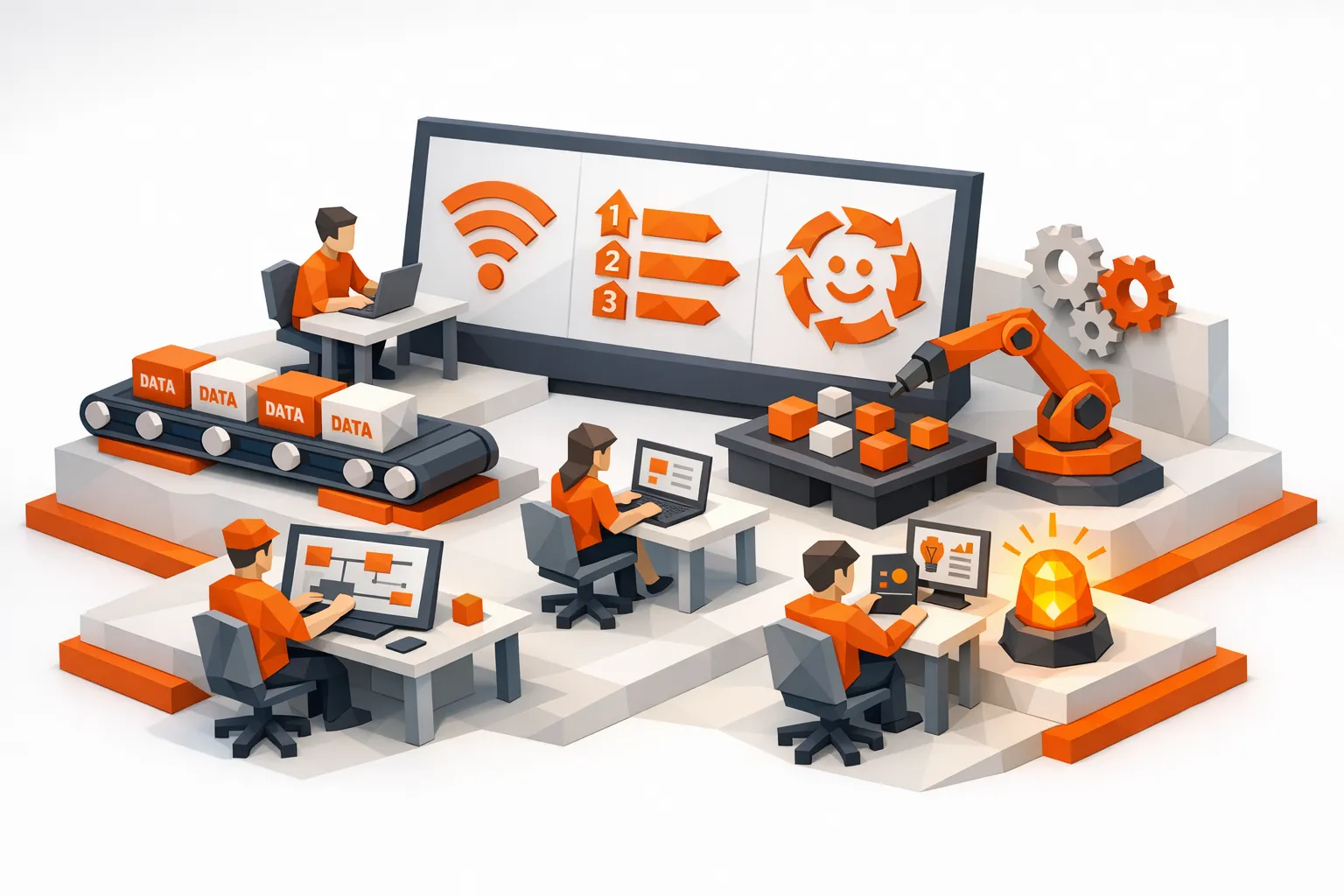
Most teams in 2026 do not “lack AI.” They lack leverage.
The winners are not the companies with the most prompts, agents, or tools. They are the ones that automate in the right order, starting with the workflows that:
Happen every day (high frequency)
Have clear inputs and outputs (standardizable)
Are easy to measure (instrumentable)
Create compounding advantage (learning loops)
That is the real unlock for AI and business in 2026: using automation to reduce time-to-signal, time-to-decision, and time-to-action, without automating the parts that still need human judgment.
Why “what to automate first” matters more in 2026
Two forces are colliding:
AI made output cheap. Drafts, summaries, and variations are abundant.
Attention and trust got more expensive. Buyers have more options, more noise, and more skepticism.
So if you automate the wrong thing first (usually “more content” or “more outbound”), you can scale activity while staying flat on outcomes.
If you automate the right thing first (usually “finding real demand,” “routing work,” and “closing the loop”), you get a system that improves every week.
This aligns with what broader research has emphasized: generative AI’s economic impact concentrates in knowledge work workflows, especially where tasks are repeatable and measurable. See McKinsey’s overview of genAI productivity potential for a useful macro lens: The economic potential of generative AI.
The 2026 automation rule: automate the mechanics, not the judgment
A practical way to avoid expensive mistakes is to split work into two buckets.
| Work type | What it looks like | Automate in 2026? | Why |
|---|---|---|---|
| Mechanics | Collecting data, labeling, routing, drafting, formatting, logging, scheduling | Yes, early | High frequency, low nuance, measurable |
| Judgment | Strategy, positioning, negotiation, sensitive customer conversations, final approvals | No, or human-in-the-loop | High downside if wrong, requires context and accountability |
This is why “AI agents” succeed most quickly when they act like operations staff, not autonomous executives.
The winners’ order of operations: Sense, Decide, Act, Learn
Most automation programs fail because they start with Act (posting, emailing, shipping) before they’ve automated Sense and Decide.
A better sequencing model is:
1) Sense (capture signals continuously)
Automate how you detect demand, risk, and opportunity.
Examples:
Monitor customer pain points across tickets, reviews, and social
Detect buying intent in public conversations (Reddit is a major one)
Track competitor mentions and comparison requests
Flag churn signals in product usage and support interactions
2) Decide (rank, score, and route)
Automate prioritization, not just collection.
Examples:
Score inbound leads by fit and urgency
Classify tickets by severity and likely resolution path
Route issues to the right owner with a clear SLA
Attach “next best action” suggestions to each item
3) Act (execute with guardrails)
Automate the parts of execution that are repetitive and reversible.
Examples:
Draft responses, proposals, and follow-ups for review
Generate tailored landing page variants for a known segment
Trigger internal workflows (create CRM tasks, update records)
4) Learn (close the loop)
Automate measurement and feedback so the system improves.
Examples:
Attribute revenue to the source conversation
Track which reply patterns convert and which get ignored
Turn repeated questions into knowledge base entries
Update scoring rules based on outcomes
Here is the same idea as a quick operating map:
| Stage | Goal | “Good automation” output | What to watch |
|---|---|---|---|
| Sense | Don’t miss what matters | High-signal alerts, not raw firehose | Precision vs. recall tradeoff |
| Decide | Put attention where ROI is | A ranked queue with reasons | False positives that waste time |
| Act | Reduce cycle time | Drafts and workflows with review points | Over-automation that harms trust |
| Learn | Improve weekly | Outcome-linked datasets and playbooks | Measuring vanity metrics only |
What winners automate first (by business function)
If you only automate one layer in 2026, automate Sense + Decide. That is where compounding advantage comes from.
Customer acquisition: intent monitoring and fast response
For growth teams, the highest leverage automation is not “more posts.” It is finding real purchase intent early and responding while the thread is alive.
This is especially true on Reddit, where many threads are essentially live “vendor shortlists,” troubleshooting requests, or tool comparisons.
What winners automate first:
Always-on monitoring for category, competitor, and problem keywords
Intent classification (is the user exploring, comparing, or ready to buy?)
Routing: who should respond, and how fast
Drafting: suggested responses that match the context and tone
Attribution: did the thread drive clicks, signups, demos, or assisted conversions
This is exactly the niche where Redditor AI sits: it uses AI to find relevant Reddit conversations and automatically promote your brand, with a simple URL-based setup. If you want a concrete example of how to operationalize this motion, start with:
The strategic point is bigger than Reddit: in 2026, distribution is a sensing problem. Teams that instrument demand capture outperform teams that “create harder.”
Sales: pipeline hygiene and “next action” automation
Sales automation wins fastest when it reduces administrative drag and shortens cycle time.
What winners automate first:
Lead enrichment and account snapshots for first calls
Call notes summarization and CRM field population
Follow-up drafts based on call outcomes (human edits, then send)
Deal risk detection (stalled stage, missing champion, no next meeting)
A useful rule: automate anything that makes reps say “I’ll update this later.” Those tasks almost never get done consistently, and inconsistency kills forecasting.
Support: triage, deflection, and knowledge reuse
Support is one of the cleanest AI ROI areas because it is high-volume, text-heavy, and measurable.
What winners automate first:
Ticket classification and routing
Suggested replies grounded in your existing docs
Duplicate detection (merge repeated issues)
“Doc gaps” detection (what customers ask that your help center does not answer)
The 2026 edge here is the Learn step: teams that automatically convert repeated tickets into better docs reduce ticket volume over time.
Product and engineering: faster understanding, not autonomous shipping
In product and engineering, automation is most valuable when it compresses research and coordination.
What winners automate first:
Summaries of bug reports and user feedback themes
Release notes drafts from merged PR descriptions
Test case suggestions for repeated bug classes (reviewed by engineers)
Incident postmortem drafts that capture timeline and contributing factors
The key boundary: use AI to accelerate comprehension and documentation, then keep humans accountable for decisions and shipping.
Finance and ops: reconciliation and anomaly detection
Ops teams win by shrinking cycle times and catching issues early.
What winners automate first:
Invoice intake, categorization, and routing for approval
Spend anomaly detection (unexpected vendor changes, spikes)
Contract metadata extraction (renewal dates, key terms)
Monthly close checklists and variance explanations drafts
This is “quiet automation” that rarely makes headlines, but it directly improves cash discipline.
HR and recruiting: workflow acceleration with guardrails
In 2026, HR automation is useful when it improves speed and consistency without turning into a black box.
What winners automate first:
Job description variants tuned to role outcomes
Candidate communication templates and scheduling flows
Interview kits (role-specific questions, scorecards)
Internal policy Q&A grounded in official documents
Keep high-stakes decisions (selection, compensation) human-led, with transparent criteria.
A prioritization matrix you can actually use
Use this table to decide what to automate first, second, and never.
| Candidate workflow | Expected impact | Implementation difficulty | Failure cost | Best first move |
|---|---|---|---|---|
| Signal monitoring (demand, issues, mentions) | High | Medium | Low | Automate now |
| Triage and routing (queues, SLAs) | High | Medium | Medium | Automate now |
| Drafting responses and follow-ups | Medium | Low | Medium | Automate with review |
| Data entry and CRM hygiene | Medium | Low | Low | Automate now |
| Outbound sending at scale | Medium | Low | High | Delay until scoring is strong |
| Autonomous public posting | Variable | Medium | High | Avoid or keep human-in-loop |
| Strategic positioning and pricing | High | High | High | Keep human-led |
If you are stuck, pick the workflow with:
Clear definition of “done”
A measurable baseline
High frequency
Low to medium downside
A 60-minute audit to pick your first two automations
You do not need a long transformation project to start. You need a short audit that produces a queue.
Create a simple worksheet with these columns:
| Task | Who does it | Frequency (per week) | Minutes each | Downside if wrong (Low/Med/High) | Metric you can track |
|---|---|---|---|---|---|
Then fill 10 to 15 tasks across growth, sales, and support.
What you are looking for:
Time sinks: high frequency times high minutes
Queue pain: tasks that create delays or missed opportunities
Measurable outcomes: anything tied to response time, conversion, or resolution
Typically, the first two winners are:
A sensing system (monitoring plus alerting)
A decision system (scoring plus routing)
The metrics winners track (because automation without measurement is just activity)
In 2026, the best automation metrics are time-based and outcome-based.
Track these consistently:
Time-to-signal: how long from a customer intent signal to your team seeing it
Time-to-first-response: especially for high-intent conversations
Queue coverage: percent of high-intent items responded to within SLA
Conversion per handled item: demos booked per P1 thread, trials per high-intent ticket, etc.
Human minutes saved: only counts if quality stays stable
Error rate: corrections, escalations, customer complaints, reopens
If you are automating Reddit as a channel, thread-level attribution (UTMs, landing page routing, and assisted conversions) matters more than raw clicks. Reddit often influences purchase decisions indirectly.
A practical 30-day rollout that does not stall
Most teams fail because they attempt a “platform rebuild.” Winners ship a narrow loop, then expand.
Week 1: baseline and instrumentation
Define one queue and one outcome metric.
Examples:
High-intent Reddit threads per week, and demos booked
Support tickets tagged “billing,” and resolution time
Inbound leads, and time-to-first-touch
Week 2: automate Sense + Decide for that queue
Set up monitoring, scoring, and routing.
For Reddit specifically, this is where tools like Redditor AI help: continuous discovery of relevant conversations and automation of brand promotion, so you are not relying on manual searching.
Week 3: add Act (drafting) with review
Introduce AI drafting that a human approves.
If you want a rigorous way to avoid publishing low-quality AI output, adopt a lightweight test suite for AI replies. This internal post is a solid operational template: Questioning AI: Tests for Trustworthy Replies.
Week 4: automate Learn
Turn outcomes into updates:
Improve scoring rules
Save winning reply structures
Update documentation based on repeated questions
Expand your keyword set and monitoring coverage
This is where the compounding effect shows up.
Where Reddit fits into “AI and business” in 2026
Reddit is not just another social channel. It is a demand capture surface where people:
Describe problems in their own words
Ask for comparisons and recommendations
Share constraints, budgets, and timelines
That means Reddit is unusually compatible with the winners’ automation order:
Sense: find the threads
Decide: rank by intent and fit
Act: draft helpful replies (with human control)
Learn: measure what converts and reuse what works
If your 2026 growth plan depends on capturing high-intent demand efficiently, an always-on listening and engagement workflow is one of the first automations worth implementing.
To see how Redditor AI approaches this end-to-end, start here: Redditor AI.

Thomas Sobrecases is the Co-Founder of Redditor AI. He's spent the last 1.5 years mastering Reddit as a growth channel, helping brands scale to six figures through strategic community engagement.