
AI in Branding: Create On-Brand Messaging Without Sounding Fake
Make AI-generated brand copy feel authentic: codify decision rules, build a compact Brand Voice Kit and messaging atoms, and run a repeatable QA loop.
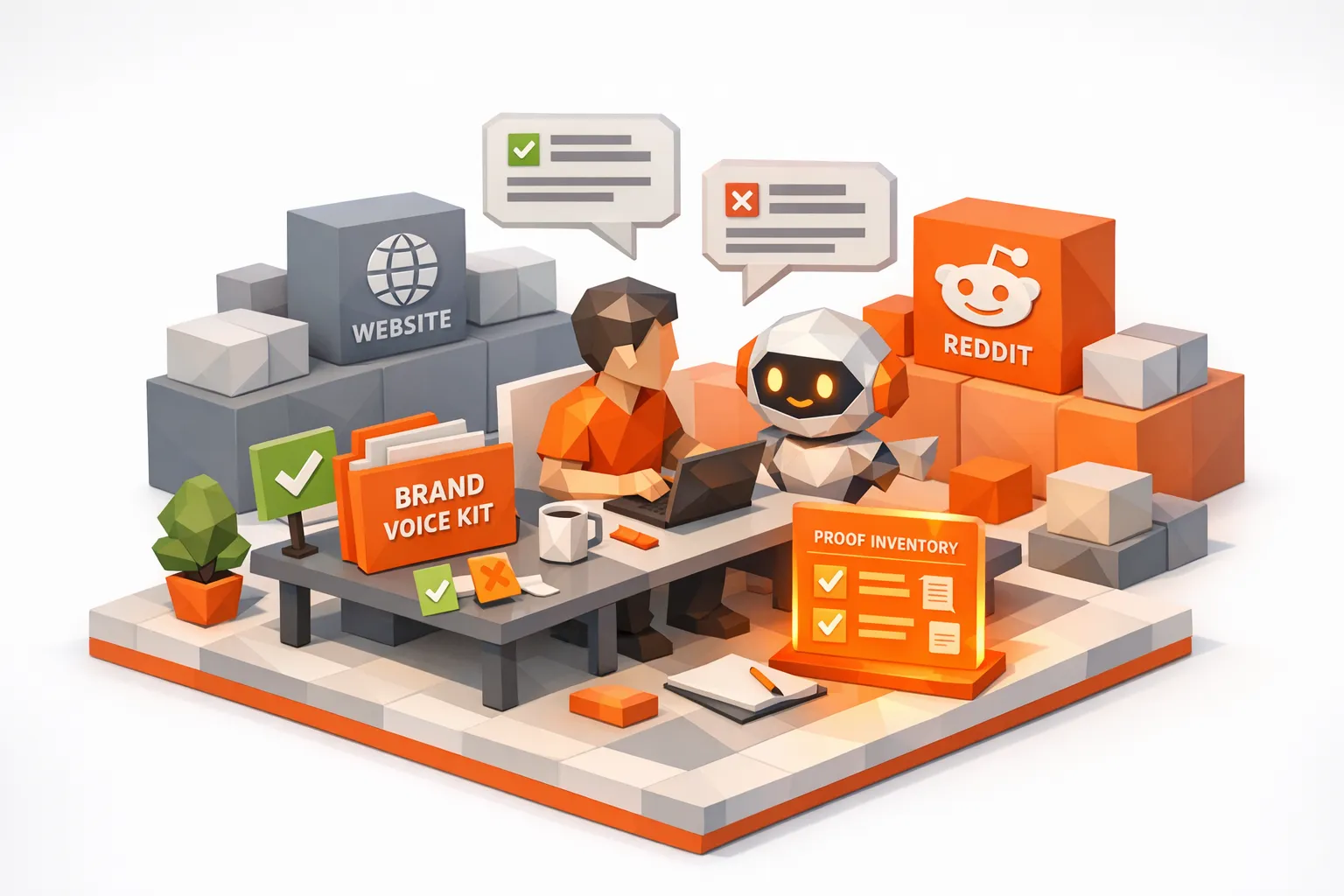
If you use AI to write brand messaging, you have probably seen the same failure mode: the copy is technically “correct”, but it reads like a polite robot trying to sell. In 2026, the risk is not that your brand sounds inconsistent. It is that your brand sounds interchangeable.
The fix is not “better prompts” in the abstract. It is better constraints, better inputs, and a repeatable QA loop. This guide shows a practical approach to AI in branding that produces on-brand messaging that still feels human.
Why AI-written brand messaging sounds fake (and why it’s predictable)
AI copy tends to feel synthetic for a few structural reasons:
1) It optimizes for safety, not truth
Default outputs often avoid sharp points of view, tradeoffs, and specificity. Humans trust brands that can say:
Who the product is for
Who it is not for
What it does well
What it does not do
If your model never says “it depends” or never names a downside, the copy reads like marketing.
2) It lacks situational context
A website headline, a sales email, and a Reddit comment are all “brand messaging”, but the social contract is different.
AI that is not given channel context will reuse the same voice everywhere. That is a fast way to sound fake.
3) It has no access to your brand’s lived reality
Your best messaging is usually built from:
Real customer objections
Specific outcomes and constraints
In-the-wild phrasing customers use
Without those inputs, AI fills the gap with generalities.
4) It overuses “performative tone”
Over-enthusiasm, empty empathy, and corporate filler are classic AI tells:
“We’re thrilled to announce…”
“In today’s fast-paced world…”
“Leverage cutting-edge solutions…”
Your audience has seen it. They are numb to it.
The core principle: “On-brand” is decision rules, not adjectives
Most teams define brand voice with adjectives: “friendly, bold, witty, premium.” That is not enough for an AI system.
To create on-brand messaging without sounding fake, define voice as decision rules:
What do we say first when someone asks for help?
How do we express uncertainty?
What claims are allowed vs not allowed?
What proof do we prefer (numbers, examples, customer quotes, comparisons)?
What is our default CTA style (soft, direct, opt-in)?
When you codify these rules, AI outputs stop being “creative writing” and become consistent, testable behavior.
Build a “Brand Voice Kit” that AI can actually follow
A useful brand kit for AI is not a 40-page PDF. It is a compact set of artifacts the model can apply in a single pass.
Here is a practical set that works well for most teams.
The 8 inputs that matter most
| Input | What it is | Why it prevents fake-sounding copy |
|---|---|---|
| Positioning sentence | “For X, we help you do Y without Z.” | Forces specificity and tradeoffs |
| Primary audience | 1–2 core personas and their context | Prevents generic “everyone” messaging |
| Problem list | Top pains in the customer’s words | Keeps language grounded |
| Proof inventory | 5–10 facts you can safely claim | Reduces overclaiming and fluff |
| Claim boundaries | What you will not claim | Prevents confident hallucinations |
| Vocabulary | Words you do use, and words you avoid | Stops corporate filler |
| Tone rules | Short rules, not adjectives | Makes voice executable |
| CTA ladder | Low friction next steps by intent level | Keeps offers natural, not pushy |
Important: Your proof inventory should only include things you can stand behind (public docs, validated numbers, or repeatable outcomes). If you do not have proof, your rule should be “use examples, not stats.”
Example tone rules (copyable)
You can adapt these as-is:
Lead with the answer, not the intro.
Use short sentences. Avoid hype.
Prefer specifics: numbers, time ranges, concrete steps.
Name tradeoffs plainly.
If uncertain, say what you would check.
Avoid superlatives (“best”, “ultimate”) unless you can prove them.
That single block does more for authenticity than most “brand voice adjectives.”
Use “messaging atoms” to stay consistent without sounding templated
Teams often try to make AI output consistent by forcing rigid templates. That creates another form of fake: copy that looks mass-produced.
A better approach is to standardize messaging atoms (small reusable components) and let the model assemble them based on context.
Common messaging atoms
Point of view: your stance on the problem
One-sentence answer: what the reader should do
Reasoning: why that works
Proof: a fact, example, or constraint
Tradeoff: what this does not solve
Next step: an opt-in CTA appropriate to intent
When your model always includes a tradeoff and a proof element, the copy feels human because humans naturally qualify and contextualize.
Channel-specific assembly (what changes, what stays)
| Channel | What stays consistent | What changes |
|---|---|---|
| Website | Positioning, proof, vocabulary | More compressed, less conversational |
| POV, tradeoffs, CTA ladder | More direct, more personalization | |
| Reddit comment | Help-first structure, honesty | More peer tone, more situational detail |
| Landing page | Proof, clarity, CTA ladder | More scannable, benefit-led sections |
The brand is consistent because the atoms are consistent. The message feels real because the assembly changes by context.
The anti-fake workflow: constrain, ground, draft, de-spam, critique
If you want reliable results, treat messaging as a pipeline, not a one-shot generation.
Step 1: Constrain the task
Give the model an explicit “unit of work”:
“Write a 120-word Reddit reply to a founder asking about X.”
“Rewrite this paragraph to match our voice rules, keep meaning identical.”
Avoid: “Write a marketing post about our product.” That invites fluff.
Step 2: Ground with real inputs
Grounding is the difference between “AI copy” and “AI-assisted writing.” Inputs that work:
A real customer question
A real thread or email
Your proof inventory
Your claim boundaries
A few “approved examples” of your writing
Step 3: Draft with messaging atoms
Instruct the model to include the atoms you care about:
Answer
Reasoning
Proof (or example)
Tradeoff
Low-friction next step
Step 4: Run a de-spam rewrite
This is the fastest way to remove AI tells.
Use a second pass that explicitly removes:
Corporate filler
Over-enthusiasm
Generic “value props”
Vague claims
Step 5: Critique against a rubric
Do not ask “is this good?” Ask for a scored evaluation.
This turns quality into an operational metric, not taste.
Prompt templates you can reuse (without making your brand sound robotic)
Template A: On-brand draft from constraints
Why it works: it forces specificity, and it forces honesty.
Template B: De-spam rewrite (keep meaning, change vibe)
Template C: Voice consistency check
A practical rubric: how to detect “AI voice” before your audience does
Here are the most common tells, and the fastest fixes.
| AI-sounding signal | What it looks like | Fast fix |
|---|---|---|
| Vague benefits | “streamline, optimize, elevate” | Replace with one concrete outcome or step |
| Overconfidence | “guarantee, will, always” | Use calibrated language (“typically”, “in many cases”) |
| Empty empathy | “I completely understand…” | Acknowledge specifics from their situation |
| Too polished | Perfectly structured paragraphs | Add a natural sentence, a caveat, or a real example |
| No tradeoffs | Only upside | Name one limitation or decision criterion |
| Generic CTA | “Book a demo” everywhere | Use a CTA ladder: ask a question, offer a link, offer to DM |
You are not trying to make it messy. You are trying to make it situational.
Make AI output feel real by upgrading your inputs (not your model)
The highest leverage move in AI in branding is feeding the model better raw material.
Build a “Phrase Bank” from real conversations
A phrase bank is a list of:
Customer-used verbs (e.g., “cobble together”, “duct-tape”, “keep missing”)
Common objections (“I don’t want another tool”, “Reddit hates promos”)
Decision criteria (“must integrate with…”, “needs to work for a team of 2”)
When AI uses their language, it feels human.
Where to pull it from:
Sales call notes
Support tickets
Customer reviews
Community threads (Reddit is especially good because people explain context)
Convert your best-performing messaging into “approved examples”
Instead of training the model on generic brand docs, give it 5–10 examples of:
A reply that earned trust
An email that got replies
A landing page section with high conversion
Then instruct the model: “match the style of these examples, not the structure.” This preserves authenticity.
The CTA ladder: stop turning every message into a pitch
One reason AI messaging sounds fake is that it tries to sell too early.
A CTA ladder keeps messaging aligned with intent:
Low intent: ask a clarifying question, offer a checklist, offer a simple link
Medium intent: offer a comparison, offer to share a short doc, invite them to describe their setup
High intent: invite a demo, trial, or direct next step
When the CTA matches intent, the brand feels like a peer, not an ad.
Where Reddit fits: your brand voice is stress-tested in public
Public conversations expose weak messaging fast. They also generate the best raw inputs for your voice kit.
If you are using Reddit as a growth channel, the difficulty is not writing one good comment. It is staying consistent across dozens of threads without copy-pasting.
This is where automation helps, as long as it is grounded in your voice rules and real context. A tool like Redditor AI is designed to find relevant Reddit conversations and automate brand promotion, so you can cover more high-intent threads without living in Reddit search all day.
A simple, brand-safe way to use automation for voice consistency is:
Use AI-driven monitoring to surface threads where your product is relevant.
Use your Brand Voice Kit and messaging atoms to generate a first draft.
Run the de-spam rewrite and rubric check.
Publish the version that sounds like a helpful human.
If you want a deeper, Reddit-specific playbook for turning threads into pipeline, the workflow in Reddit Lead Generation Playbook: From Threads to Demos pairs well with the voice system in this article.
A lightweight operating system for on-brand AI messaging (weekly, not theoretical)
Most teams fail because they treat AI messaging as a creative task, not an operational loop.
Here is a pragmatic cadence:
Weekly: update the inputs
Add 10 new phrase bank entries from real conversations.
Add 1 new approved example (a reply or email that worked).
Update the proof inventory if something changed.
Weekly: review output quality with 20-minute sampling
Pick 10 AI-assisted messages and score them with the rubric:
If “sounds human” scores drop, tighten de-spam rules.
If “claim integrity” scores drop, tighten boundaries.
If “specificity” scores drop, add more examples and phrase bank entries.
This creates compounding improvements without rewriting your whole brand guide.
The bottom line
“On-brand” AI messaging is not about making your model sound clever. It is about making your brand’s decision rules explicit, feeding the model grounded inputs, and running a QA loop that removes AI tells.
If you do that, AI stops making your brand feel fake. It becomes a system for scaling what already works.
To apply this in real conversations (especially on Reddit), start by operationalizing your monitoring and response workflow. Redditor AI can help you find relevant threads and automate engagement, while your Brand Voice Kit ensures the output still sounds like you.

Thomas Sobrecases is the Co-Founder of Redditor AI. He's spent the last 1.5 years mastering Reddit as a growth channel, helping brands scale to six figures through strategic community engagement.