
AI Search for Reddit Leads: Keywords to Threads
Practical guide to convert keyword lists into repeatable Reddit thread discovery — seed keywords, modifiers, query templates, subreddit layering, scoring, and AI automation.
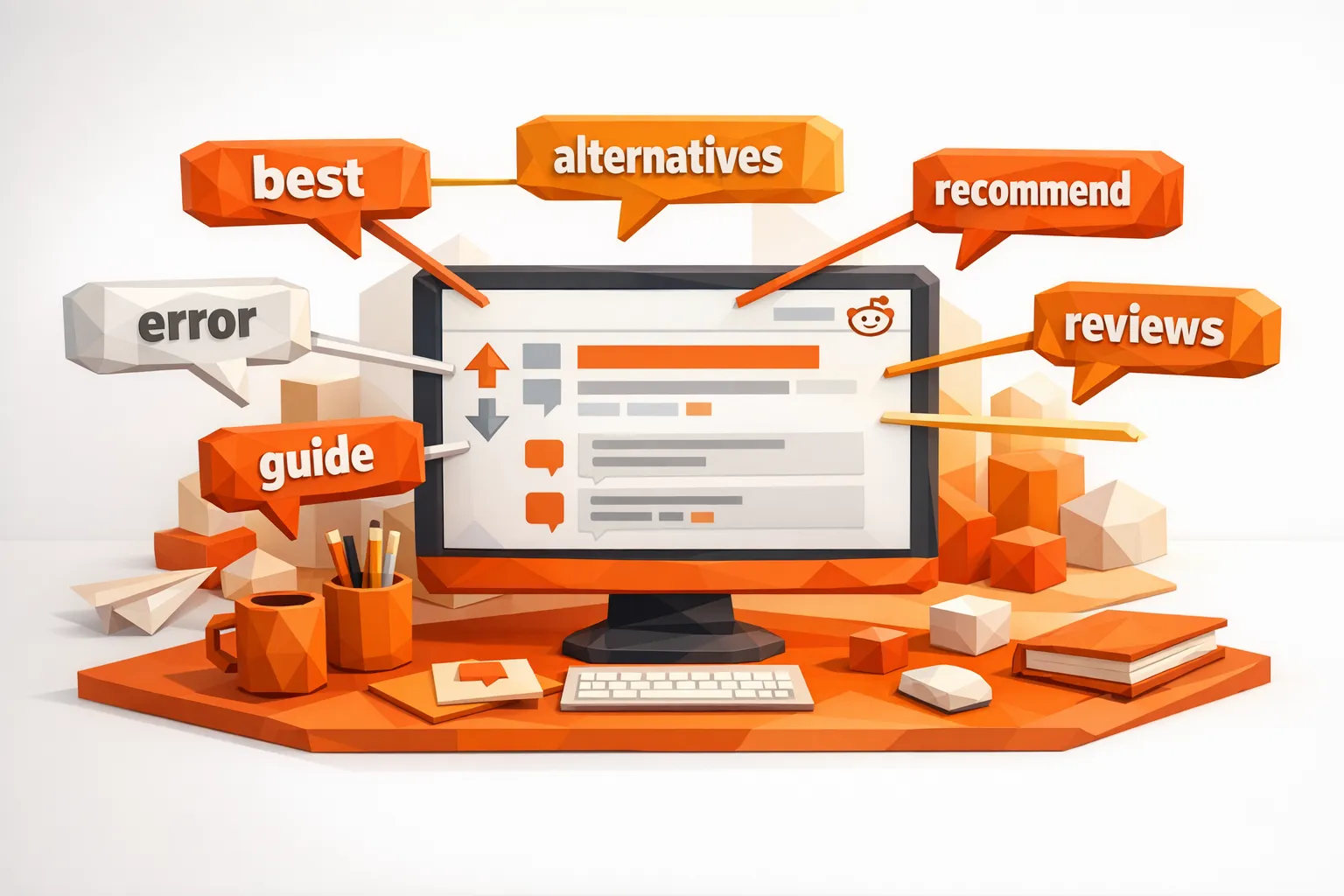
Reddit is full of people who are already describing the problem your product solves, they just rarely use your exact brand name. That is why “AI search for Reddit leads” is less about finding mentions and more about translating buyer language (keywords) into threads you can respond to.
This guide shows a practical way to go from a messy keyword list to a clean, repeatable “thread discovery system” you can run manually, or automate.
Keywords are not the goal, threads are
A Reddit lead is almost never a keyword match in isolation. It is a situation.
Someone is:
Evaluating options (“best”, “alternatives”, “vs”)
Trying to implement something (“how do I”, “setup”, “workflow”)
Stuck (“error”, “not working”, “recommendation?”)
Planning spend (“pricing”, “budget”, “worth it”)
So the job is to build keyword patterns that consistently surface those situations, in the subreddits where your buyers hang out.
Step 1: Build a seed keyword set that reflects buyer language
Most teams start with category keywords (“CRM”, “time tracking”, “help desk”). That is necessary, but it is rarely sufficient.
To find leads on Reddit, you want a mix of:
Category terms (what the thing is)
Job-to-be-done verbs (what they are trying to do)
Pain language (what is failing, slow, expensive, confusing)
Tooling context (integrations, stack, platforms)
Competitors and substitutes (what they compare against)
A simple way to assemble this is to open 20 to 50 relevant threads and copy the exact nouns and verbs people repeat. Reddit language is often more direct than what you see in SEO tools.
Use this table as a seed framework:
| Keyword bucket | What it captures | Example seed keywords (generic examples) |
|---|---|---|
| Category | Broad “what” | help desk, project management, email warmup |
| JTBD verbs | The action | automate, track, migrate, monitor, reconcile |
| Pains | Urgency and friction | too slow, messy, keeps breaking, manual, overpriced |
| Constraints | Fit qualifiers | for small team, enterprise, HIPAA, SOC 2, EU, budget |
| Integrations | Stack clues | Shopify, HubSpot, Slack, Stripe, Notion |
| Competitors | Comparison intent | alternative to X, X vs Y, similar to X |
Two practical tips that improve lead quality fast:
Prefer phrases over single words. “client reporting” is better than “reporting”.
Capture “embarrassing” wording. People will write “I’m drowning in spreadsheets” before they write “I need an analytics platform”.
Step 2: Convert keywords into “thread-finding” modifiers
A keyword becomes a lead query when you combine it with a modifier that signals intent.
Think of it like this:
Keyword = topic
Modifier = moment in the buyer journey
Thread = opportunity
Here is a set of modifiers that tend to surface high-intent threads (pick the ones that match your funnel and price point):
| Modifier pattern | What it usually means | Typical intent level |
|---|---|---|
| “best [category]” | Actively selecting | High |
| “[category] alternatives” | Shortlist building, dissatisfied with incumbent | High |
| “[tool] vs [tool]” | Decision framing | High |
| “recommend [category]” | Wants human validation | Medium to high |
| “anyone using [tool]” | Social proof and real experiences | Medium to high |
| “how do I [job]” | Implementation stage | Medium (often converts well) |
| “[job] workflow” | Looking for a repeatable process | Medium |
| “problem with [tool]” / “issue” | Switching trigger, frustration | High |
| “[tool] pricing” / “worth it” | Budget and justification | High |
When you build queries, you are not trying to catch every thread. You are trying to catch the threads that match your best conversion motion.
Example:
If you sell a developer tool, “error”, “stack trace”, and “how do I” can be more valuable than “best”.
If you sell a B2B SaaS with competitors, “alternatives” and “vs” threads often convert exceptionally well.
Step 3: Turn modifier patterns into reusable query templates
Once you have 10 to 30 seed keywords, you can create a small library of query templates.
You can run these templates in Reddit’s search, third-party Reddit search tools, or through an automated monitor.
Reddit supports several search operators (documented in the Reddit search wiki), which can help you narrow results by subreddit, author, and more.
Here are practical templates you can adapt (shown with common operators like subreddit: and title:):
| Goal | Template | Example |
|---|---|---|
| Find decision threads in titles | title:(best OR alternatives OR vs) [category] | title:(best OR alternatives OR vs) help desk |
| Narrow to a buying subreddit | subreddit:[target] title:([modifier]) [keyword] | subreddit:smallbusiness title:(best OR recommend) invoicing |
| Catch implementation questions | title:(how OR setup OR workflow) [job] [tool/context] | title:(how OR setup) automate reporting shopify |
| Catch switching triggers | title:(alternatives OR replace OR switching) [competitor/tool] | title:(alternatives OR replace) Intercom |
| Catch pain language | title:(issue OR problem OR broken) [keyword] | title:(problem OR broken) email warmup |
Notes that matter in practice:
Title-first searching is underrated. Many of the most convertible threads are explicit questions, and the title captures the intent cleanly.
Your first pass should be broad. Over-filtering early often hides the exact phrasing you need to add to your library.
Step 4: Map queries to a “subreddit layer cake”
If you only search one subreddit, you miss volume. If you search all of Reddit, you drown in noise.
A reliable middle ground is to build layers:
Layer 1 (category hubs): big general subreddits where the topic appears regularly
Layer 2 (buyer subreddits): where the buyer persona hangs out (founders, ops, creators, devs)
Layer 3 (problem niches): where your product is an obvious fit (a specific workflow, tech stack, or vertical)
This reduces noise without destroying discovery.
A practical way to build your initial list is:
Start with 5 to 10 obvious subreddits.
Look at where high-quality threads are cross-posted or referenced.
Add 10 to 30 “adjacent intent” subreddits where the job-to-be-done shows up.
If you want a deeper end-to-end system for turning threads into pipeline, pair this approach with the workflow in Reddit lead generation playbook: from threads to demos.
Step 5: Score threads so you spend time where it converts
Once your search surfaces threads, you need a consistent way to decide what to answer first. This is where most “Reddit monitoring” setups break, they capture too much and prioritize nothing.
A lightweight scoring model (even if you do it manually at first) makes the system usable.
Here is a practical scoring table you can copy into a spreadsheet:
| Signal | What to look for | Why it matters |
|---|---|---|
| Explicit ask | “best”, “recommend”, “alternatives”, “vs” | The user is inviting options |
| Concrete constraints | budget, team size, location, tech stack | Helps you qualify and personalize |
| Switching trigger | “we’re leaving X”, “X is too expensive” | High purchase intent |
| Recency | posted in last hours or days | Early replies get more visibility |
| Engagement | active comments, back-and-forth from OP | Higher chance of response |
| Fit clarity | your product solves it cleanly | Prevents wasted replies |
You can keep it simple: prioritize threads that have both explicit ask and constraints.
Step 6: Use “keyword to thread” chaining to catch hidden intent
Some of the best leads do not use category language at all.
Example patterns:
They describe the outcome (“reduce churn”, “stop chargebacks”, “ship faster”) instead of the tool type.
They mention the constraint (“HIPAA compliant”, “works with Shopify”) before they mention the category.
To capture that, build chains.
A chain is 2 to 4 query variants that start broad and end in buyer language.
Example chain (generic):
Broad: “best onboarding tool”
Switching: “onboarding tool alternatives”
Outcome: “reduce user churn onboarding”
Constraint: “onboarding for B2B SaaS Slack integration”
You do not need dozens of chains. In practice, 5 to 15 chains per product category can cover most of the “money threads”.
Step 7: Don’t stop at finding threads, operationalize them
Search is only the front door. If you want leads, you need a path from “thread found” to “thread responded” to “lead captured”.
At minimum, define:
Response owner: who replies (founder, growth, support, agency)
Response window: how fast you try to show up for high-intent threads
Destination: where you send interested users (a short landing page, doc, demo link, waitlist)
Tracking: a way to attribute outcomes back to the thread (UTMs are usually enough)
If you are building toward a repeatable motion, the fastest way is to treat each thread as a mini-campaign with a measurable outcome.
For response tactics and conversion patterns, the playbook in Turn Reddit mentions into customers: fast response tactics pairs well with the keyword system in this article.
Where AI fits: from manual searching to always-on lead discovery
Manual search is a great way to learn the language. It is a weak way to run the channel long term.
The moment you have:
multiple subreddits,
multiple keyword chains,
and a need to respond quickly,
…you are doing monitoring work, not “occasional searching”.
This is where AI automation helps: continuously watching Reddit for your keyword-to-thread patterns, prioritizing results, and making it easy to respond while context is still hot.
Redditor AI is built for exactly that workflow: it uses AI-driven Reddit monitoring to find relevant conversations and can automatically promote your brand. Setup is URL-based, so you start from what you sell and work backward into the threads where buyers are already asking.
If you want a broader overview of how automation fits into a conversion-focused motion, see Everything you need to know about Reddit automation.
A simple 30-minute exercise to build your first query pack
If you want to leave this article with something you can use today, do this:
Pick one product or offer, then:
Write 10 seed keywords across category, JTBD verbs, pains, constraints, and competitor names.
Choose 5 modifiers that match your funnel (for most B2B, start with: best, alternatives, vs, recommend, pricing).
Combine them into 20 to 40 searches, then skim results to find the phrases you missed.
Keep the queries that repeatedly surface explicit asks and real constraints.
Within a week of doing this consistently, you usually end up with a compact query library that produces far more leads than generic “brand monitoring” ever will.
The core idea to remember
“AI search for Reddit leads” works when you stop thinking like a keyword tool and start thinking like a thread detective.
Keywords are inputs. Threads are opportunities. Your advantage comes from translating how buyers talk into a system that finds those moments early, over and over again.

Thomas Sobrecases is the Co-Founder of Redditor AI. He's spent the last 1.5 years mastering Reddit as a growth channel, helping brands scale to six figures through strategic community engagement.