
How to Monitor Reddit for Competitor Comparison Threads
A practical guide to finding Reddit threads where buyers compare tools, evaluate alternatives, and reveal high-intent opportunities for your brand.
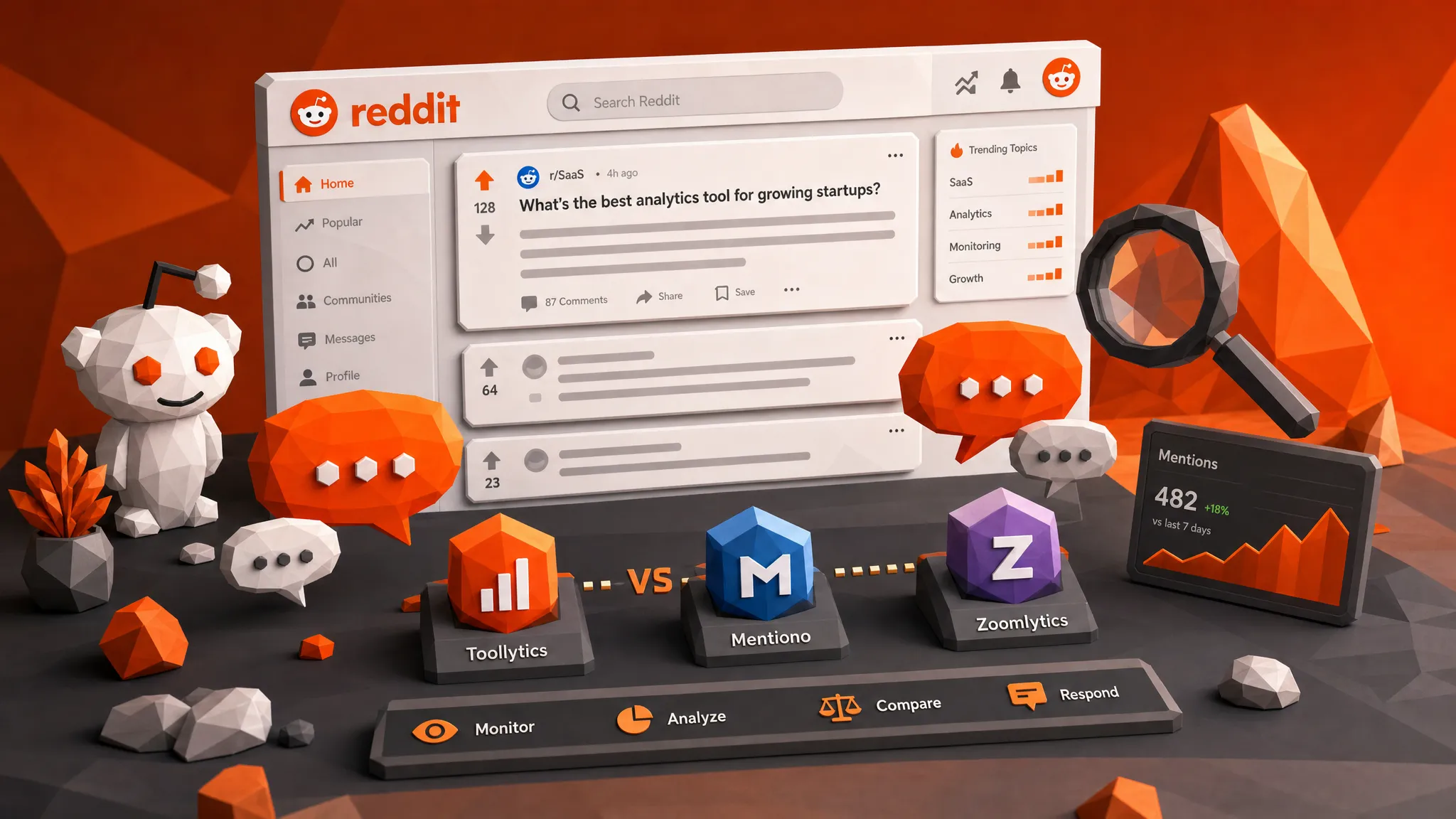
Monitoring Reddit for competitor comparison threads is one of the highest-leverage forms of Reddit marketing because the buyer has already done the hard part for you. They are not just browsing. They are comparing tools, naming vendors, explaining constraints, and asking strangers which option they should trust.
That makes these threads different from generic brand mentions. A post that says someone used your competitor is useful, but a thread asking whether Competitor A or Competitor B is better for a specific use case is actionable. It tells you the buyer’s shortlist, the decision criteria, the objections, and often the timeline.
The challenge is that comparison threads are messy. They rarely use the exact phrasing you expect. Some appear as X vs Y posts. Others show up inside comments on broader recommendation threads. Many never mention your brand at all, even though they are perfect opportunities for you to enter the conversation.
This guide shows how to monitor Reddit for competitor comparison threads with a practical system: map your competitor universe, build high-signal query lanes, classify real buying intent, route the best threads, and measure which comparisons turn into leads.
What counts as a competitor comparison thread?
A competitor comparison thread is any Reddit discussion where users evaluate two or more ways to solve the same problem. The key is not whether your brand is mentioned. The key is whether the buyer is weighing options in your market.
These threads often sit in the middle or bottom of the funnel. The user may not be ready to buy today, but they are actively reducing uncertainty. If your reply helps them understand tradeoffs, you can influence the decision before a sales call, ad click, or demo request ever happens.
| Thread type | Example pattern | Why it matters |
|---|---|---|
| Direct vendor comparison | Competitor A vs Competitor B | The buyer has a shortlist and wants a decision framework. |
| Shortlist review | Which of these tools should I use? | You can position your product against multiple alternatives at once. |
| Switching thread | Moving away from Competitor A, what should I use? | Pain is explicit and the user is open to change. |
| Pricing comparison | Is Competitor A worth the price compared to Competitor B? | Budget friction is visible and can shape your response. |
| Use-case fit comparison | Best tool for agencies, founders, teams, or a specific workflow | The decision is tied to an audience segment you may serve well. |
| Stack comparison | Should I use Competitor A with Tool B or choose Competitor C? | Integration and workflow context can reveal high fit. |
The best monitoring systems look for all of these patterns, not just exact X vs Y titles.
Start with a competitor comparison map
Before writing queries, build a competitor comparison map. Most teams monitor only obvious competitors, which creates a blind spot. Reddit users often compare your category against adjacent tools, manual workflows, free options, legacy products, agencies, templates, open-source projects, or doing nothing.
Your map should include direct competitors, indirect competitors, and substitute solutions. If you sell a SaaS tool, for example, your alternatives might include spreadsheets, consultants, internal scripts, and larger platforms that include your feature as part of a suite.
Create one row per competitor or substitute. The goal is to give your monitoring system enough context to catch threads where the buyer is comparing outcomes, not just brand names.
| Field | What to capture | Example |
|---|---|---|
| Competitor name | Canonical product, company, or substitute | Competitor A |
| Aliases | Misspellings, abbreviations, old names, product modules | CompA, CA, old product name |
| Comparison triggers | Phrases that suggest evaluation | vs, compared to, switching from, worth it |
| Buyer context | Audiences that make the thread relevant | solo founder, agency, B2B SaaS team |
| Disqualifiers | Signals that make the thread low value | academic research, jobs, investing, memes |
| Best destination | Page or asset to use if the thread converts | comparison page, demo page, guide, waitlist |
This map becomes the source of truth for your Reddit monitoring. It also helps AI-powered systems understand what a meaningful comparison looks like for your business.
If you have not built your core keyword structure yet, start with a broader Reddit keyword pack, then add the competitor comparison layer on top.
Build query lanes, not one giant alert
A common mistake is setting one alert for each competitor name and calling it monitoring. That catches direct mentions, but it misses the decision-shaped conversations that matter most.
Instead, build query lanes. Each lane represents a different way buyers compare options. You can run these through Reddit search, Google search with Reddit filters, social listening tools, or a purpose-built Reddit monitoring system.
| Query lane | Template | What it catches |
|---|---|---|
| Direct comparison | Competitor A vs Competitor B | Clean side-by-side evaluation threads. |
| Category shortlist | best category tool for use case Competitor A | Threads where a competitor appears in a broader shortlist. |
| Switching intent | switching from Competitor A | Buyers dissatisfied with a current vendor. |
| Replacement intent | replace Competitor A | Users looking for an alternative with urgency. |
| Pricing pressure | Competitor A pricing worth it | Buyers questioning value or cost. |
| Experience request | anyone used Competitor A and Competitor B | Users asking for real-world feedback. |
| Migration concern | Competitor A to Competitor B | Threads about moving data, workflows, or teams. |
| Problem-led comparison | tool for problem Competitor A Competitor B | Comparisons hidden inside pain-point discussions. |
Do this for your top competitors first. Then expand to clusters. For example, instead of only tracking Competitor A vs Competitor B, also monitor Competitor A against the category phrase, the use case, and the pain point.
The more specific your lane, the less noise you get. The broader the lane, the more discovery you unlock. A healthy system uses both.
Include comments, not just post titles
Many of the best competitor comparison threads do not start as comparison posts. A user asks a broad question like what should I use for this workflow, then the real comparison happens in the comments.
That matters because Reddit comments often contain the richest buying signals. Users explain why they left a tool, which features broke, how pricing changed, what their team rejected, and which option they are leaning toward. If you only monitor post titles, you miss the market intelligence that actually helps you win.
Your monitoring should capture at least three layers of context:
The post title, because it reveals the stated intent.
The original post body, because it contains constraints and urgency.
The comment thread, because it surfaces competitor sentiment, objections, and recommendations.
This is where simple mention alerts often fall short. They can tell you that a competitor was mentioned, but not whether the mention is a buying opportunity, a complaint, a fan recommendation, or an irrelevant tangent.
Add semantic filters so you catch messy comparisons
Reddit users do not write like search marketers. They say things like I narrowed it down to these two, is this overkill, what are people using now, or I keep hearing about this other tool. Those phrases can signal comparison intent even if the word compare never appears.
AI can help by classifying the meaning of a thread instead of relying only on exact keywords. For competitor comparison monitoring, the classification layer should identify:
| Signal | What to extract | Why it helps |
|---|---|---|
| Vendors mentioned | Product names, aliases, category substitutes | Shows who is in the decision set. |
| Decision stage | Researching, shortlisting, switching, buying soon | Helps prioritize response speed. |
| Primary criteria | Price, reliability, support, integrations, ease of use | Shapes the angle of your reply. |
| Current solution | What the user uses today | Reveals migration friction and dissatisfaction. |
| Objections | Reasons users reject options | Feeds sales messaging and landing pages. |
| Fit indicators | Company size, use case, workflow, geography | Prevents wasting time on poor-fit threads. |
| Response opportunity | Whether a helpful brand reply would add value | Separates leads from pure research noise. |
This is the difference between Reddit monitoring and Reddit lead generation. Monitoring finds mentions. Lead generation identifies moments where your brand can help the buyer make a better decision.
Prioritize with a simple comparison-thread score
Not every comparison thread deserves the same attention. A three-year-old post with vague curiosity should not be handled like a fresh thread where a buyer asks for a tool this week.
Use a lightweight scoring model to route your queue. You do not need a complex machine-learning system to start. You need consistent criteria that your team or AI can apply every day.
| Factor | Score range | What a high score looks like |
|---|---|---|
| Comparison clarity | 0-5 | The user names vendors or asks for a clear shortlist decision. |
| Buyer intent | 0-5 | The user is choosing, switching, budgeting, or implementing soon. |
| Product fit | 0-5 | The use case matches your strongest customer segment. |
| Competitor relevance | 0-5 | The named competitor is one you can credibly replace or complement. |
| Timing | 0-5 | The thread is recent or still active. |
| Reply opportunity | 0-5 | A helpful answer can add new context without forcing a pitch. |
You can convert the total into a P1/P2/P3 queue.
| Priority | Score guide | Action |
|---|---|---|
| P1 | 24-30 | Review quickly, respond with a tailored comparison, and track clicks or replies. |
| P2 | 16-23 | Save for same-day review, answer if your product has a clear fit. |
| P3 | 8-15 | Log for research, messaging, or future content ideas. |
| Ignore | 0-7 | Skip unless it reveals a recurring competitor objection. |
For a deeper prioritization model, use this with a dedicated Reddit lead scoring framework.
Set up a daily monitoring workflow
Competitor comparison monitoring works best when it becomes an operating rhythm, not a random alert inbox. The point is to build a repeatable system that finds relevant conversations while they are still fresh.
Refresh the competitor map weekly: Add new vendors, aliases, feature names, and substitute options you see in Reddit threads, sales calls, support tickets, and search data.
Run query lanes continuously: Monitor direct comparisons, switching phrases, pricing questions, migration concerns, and use-case shortlist discussions.
Capture full thread context: Save the title, post body, comments, subreddit, timestamp, permalink, competitors mentioned, and the user’s stated criteria.
Classify intent and fit: Score each thread based on comparison clarity, buyer intent, product fit, timing, and reply opportunity.
Route only the best threads: Send P1 threads to whoever can respond fast, keep P2 threads in a same-day queue, and use P3 threads for research.
Review outcomes weekly: Track which competitors, subreddits, and comparison angles produce clicks, replies, signups, demos, or qualified conversations.
The weekly review is where the system compounds. You will discover that some competitor names create lots of noise, while others reliably surface active buyers. You will also learn which objections are repeated often enough to deserve a landing page, sales battlecard, or product positioning update.
What to do when a comparison alert hits
The best response to a competitor comparison thread is not a sales pitch. It is a useful decision aid. Your goal is to help the buyer understand tradeoffs, then make it easy for them to learn more if your product is relevant.
A strong reply usually includes four parts: acknowledge the decision, define the criteria, compare tradeoffs honestly, and offer a low-pressure next step. You do not need to attack competitors. In fact, the most persuasive Reddit replies often say who should choose each option.
| Thread signal | Useful response angle |
|---|---|
| User asks X vs Y | Explain the main difference in fit, workflow, or cost. |
| User complains about a competitor | Address the pain point directly and explain what to check before switching. |
| User asks for a shortlist | Map options by use case instead of claiming one universal winner. |
| User worries about pricing | Discuss total cost, implementation time, and what value justifies the price. |
| User mentions migration | Share a practical migration checklist or caveats to consider. |
If you need reply examples, adapt templates from a dedicated Reddit reply framework so your team can respond consistently without sounding generic.
Track competitor comparison threads back to revenue
If you only measure upvotes, you will underestimate the value of comparison monitoring. The real goal is to understand which discussions influence pipeline.
At minimum, keep a thread ledger. It can be a spreadsheet, CRM object, Notion table, or tool-based queue. Each row should preserve the thread URL and the business outcome.
| Field | Why it matters |
|---|---|
| Thread URL | Lets you revisit the exact conversation. |
| Subreddit | Shows where comparison demand appears repeatedly. |
| Competitors mentioned | Identifies which alternatives create opportunities. |
| Intent score | Helps compare thread quality over time. |
| Reply status | Tracks whether the thread was handled. |
| Destination URL | Connects the thread to the page you sent users to. |
| UTM content | Separates clicks by thread or comment. |
| Outcome | Captures reply, click, signup, demo, sale, or assisted conversion. |
For attribution, use consistent UTM conventions so each click can be tied back to a specific Reddit thread or comment. The simplest version is utm_source=reddit, a stable campaign name, and utm_content that references the subreddit and thread. For a full setup, use a dedicated UTM strategy for Reddit.
The most useful weekly metrics are practical: number of high-intent comparison threads found, time to discovery, time to response, reply-to-click rate, click-to-lead rate, and competitor themes. Over time, those metrics tell you where to invest, which competitors to monitor more aggressively, and which comparison pages to build.
Common mistakes to avoid
The biggest mistake is monitoring only your own brand. If a buyer is comparing two competitors and you are not named, that may still be your best chance to enter the market conversation.
Another mistake is over-indexing on exact X vs Y phrases. Direct comparison searches are useful, but many buying moments look like troubleshooting, switching, pricing, or shortlist questions.
Watch for these failure modes:
Ignoring comments where the real vendor debate happens.
Treating every competitor mention as a lead, even when there is no decision intent.
Forgetting aliases, abbreviations, acquired product names, and common misspellings.
Sending every alert to the same inbox without priority scoring.
Replying before understanding the user’s criteria.
Linking to a generic homepage instead of a thread-matched page.
Failing to log outcomes, which makes the channel feel anecdotal.
If you already monitor general competitor mentions, this workflow is the next layer. General mention monitoring tells you what people say about competitors. Comparison monitoring tells you when someone is deciding between options.
How Redditor AI helps automate comparison monitoring
Manual monitoring works when you have a few competitors and a narrow market. It breaks down when your category has many aliases, fast-moving threads, and comparison language hidden inside comments.
Redditor AI is built to find relevant Reddit conversations and promote your brand automatically. Instead of relying on one-off alerts, you can use AI-driven Reddit monitoring to surface conversations where your product is relevant, including competitor comparison threads, switching discussions, and category recommendation posts.
The URL-based setup is useful because your website gives the system context about what you sell, who you serve, and which conversations are likely to matter. From there, Redditor AI can help turn Reddit conversations into a repeatable acquisition channel rather than a manual research task.
Use automation for the parts that should not depend on human memory: scanning, matching, prioritizing, and keeping the queue fresh. Keep your strategy focused on the parts that create leverage: positioning, offer fit, conversion destinations, and learning from the comparison themes buyers repeat.
Frequently Asked Questions
How do I find competitor comparison threads on Reddit? Start with competitor names and aliases, then add comparison triggers such as vs, compared to, switching from, replace, worth it, pricing, and anyone used. Monitor both posts and comments because many comparisons happen inside broader recommendation threads.
Should I monitor competitors even if my brand is not mentioned? Yes. Some of the best opportunities are threads where buyers compare competitors but have not discovered your product yet. If your solution is relevant, the thread can become a high-intent acquisition opportunity.
What is the difference between competitor mentions and competitor comparison threads? A competitor mention can be any reference to another brand. A competitor comparison thread includes evaluation, tradeoffs, switching intent, pricing concerns, or a shortlist decision. Comparisons are usually more actionable for lead generation.
How often should I check Reddit for comparison threads? For active categories, monitor continuously or at least daily. Freshness matters because early helpful replies can shape the discussion before the thread becomes crowded or the buyer makes a decision.
Can AI monitor Reddit comparison threads accurately? AI can improve accuracy by reading context, identifying buyer intent, extracting named competitors, and filtering out low-value mentions. The best results come from combining AI monitoring with a clear competitor map and outcome tracking.
What should I send users to from a comparison thread? Avoid sending every user to your homepage. Use a page or resource that matches the thread intent, such as a comparison page, use-case guide, migration checklist, pricing explainer, demo page, or waitlist page.
Turn comparison threads into a repeatable lead channel
Competitor comparison threads are where buyers reveal the decision they are trying to make. If you monitor them well, you get more than leads. You get messaging insight, objection data, competitor intelligence, and a direct path into conversations that already have commercial intent.
The winning system is simple: map your competitors, monitor comparison language, score threads by intent and fit, respond with useful context, and track the outcome back to revenue.
If you want to automate that workflow, try Redditor AI. It helps find relevant Reddit conversations on autopilot and promotes your brand where your product can be part of the buyer’s decision.

Thomas Sobrecases is the Co-Founder of Redditor AI. He's spent the last 1.5 years mastering Reddit as a growth channel, helping brands scale to six figures through strategic community engagement.