
How to Monitor Reddit Competitors for Sales Opportunities
A practical guide to finding high-intent competitor mentions on Reddit, scoring buying signals, and turning relevant conversations into sales opportunities.
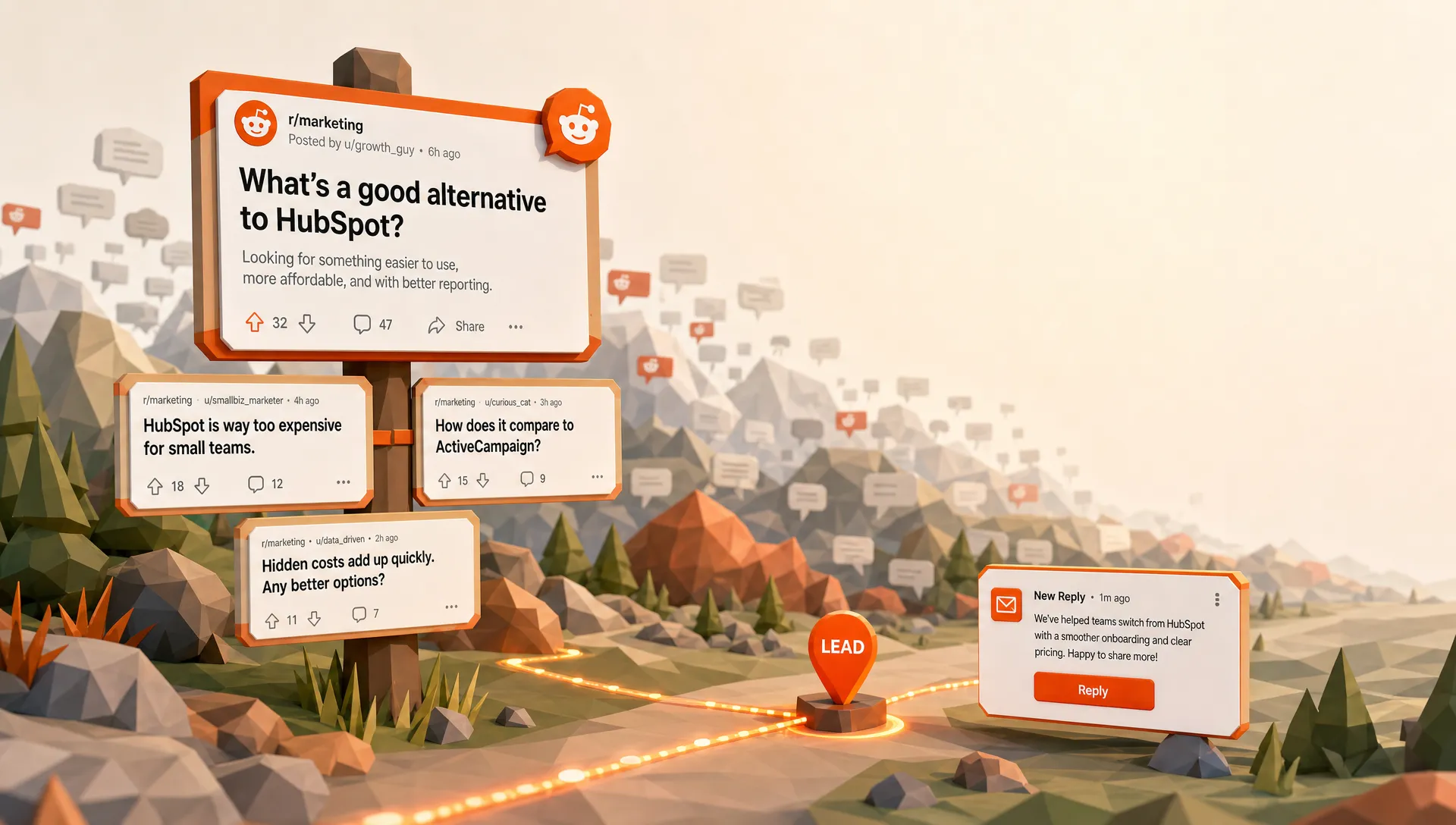
Competitor mentions on Reddit are not just brand intelligence. They are live sales signals.
When someone asks, “Is there a better alternative to [competitor]?” or posts a long complaint about a tool they already pay for, they are often much closer to buying than a cold outbound prospect. They have a problem, they know the category, and they are asking peers for help in public.
The challenge is that Reddit is noisy. A competitor name might appear in a rant, a recommendation thread, a meme, a technical troubleshooting post, or a high-intent buying discussion. Monitoring competitors for sales opportunities means separating casual chatter from moments where your team can genuinely help and potentially win a customer.
Below is a practical system for finding, prioritizing, and acting on competitor-related Reddit conversations without wasting hours scrolling.
What makes a competitor mention a sales opportunity?
Not every competitor mention deserves a reply or a sales follow-up. The best opportunities usually contain three things: context, dissatisfaction or evaluation, and openness to alternatives.
A post that says “I use [competitor]” is weak. A post that says “I use [competitor], but it is too expensive for a small team and support has been slow. Any alternatives?” is strong.
| Reddit signal | Sales intent level | Why it matters | Best next move |
|---|---|---|---|
| “[Competitor] alternative” | Very high | The user is actively looking for options | Reply with a helpful comparison angle |
| “Is [competitor] worth it?” | High | The user is evaluating before purchase | Address the decision criteria in the thread |
| “How do I fix [competitor issue]?” | Medium to high | The user has pain, but may not be ready to switch | Help first, then mention a better workflow if relevant |
| “I’m leaving [competitor]” | Very high | The user has churn intent | Ask what they need next and offer a migration-friendly path |
| “Best tool for [use case]?” | High | Competitors may not be named, but the category intent is clear | Position your brand around the use case |
| “Anyone using [competitor]?” | Medium | The user is gathering opinions | Share balanced pros, cons, and alternatives |
This is the core idea behind competitor-based Reddit lead generation: you are not chasing mentions, you are finding buying moments.
Start with a competitor intelligence map
Before setting up alerts or searches, define exactly what you want to monitor. Most teams only track direct competitor names, which misses a large share of demand.
Build a simple competitor map with four groups:
Direct competitors that solve the same problem for the same buyer.
Indirect competitors that solve the same problem in a different way.
Legacy tools, spreadsheets, manual workflows, agencies, consultants, or internal solutions that buyers use instead of software.
Category terms that buyers use before they know which vendors exist.
For example, if you sell a project management tool, monitoring only “Asana” and “Monday” is too narrow. You may also want to track “spreadsheet project tracker,” “client portal,” “task management for agencies,” and “how to manage recurring work.”
This matters because Reddit users often describe problems before they mention products. A competitor might be implied through the workflow, not named directly.
Find the subreddits where competitor demand appears
The best Reddit sales opportunities are usually concentrated in a handful of communities. Some are obvious category subreddits. Others are role-based, problem-based, or industry-specific.
Look for subreddits where people discuss:
Buying software or services in your category.
Switching away from tools they already use.
Troubleshooting workflows your product improves.
Budget, pricing, implementation, or support frustrations.
Peer recommendations for specific use cases.
A CRM company, for instance, should not only monitor CRM-focused subreddits. It may also find better conversations in communities for sales leaders, solo founders, consultants, real estate agents, or small business owners.
If you need a more detailed process for identifying communities with real commercial intent, this guide on finding high-intent subreddits for your niche is a useful companion.
Build competitor monitoring queries around intent
Once you know which competitors and subreddits matter, create queries that combine brand names with buying language. This is where many teams go wrong. Searching only for a competitor name produces too much noise.
Instead, combine competitor names with phrases that indicate evaluation, frustration, switching, or urgency.
| Query pattern | Example | What it finds |
|---|---|---|
| Competitor + alternative | “HubSpot alternative” | Users actively seeking replacements |
| Competitor + pricing | “HubSpot pricing too expensive” | Budget-driven switching intent |
| Competitor + problem | “HubSpot support issue” | Dissatisfaction and pain |
| Competitor + comparison | “HubSpot vs Pipedrive” | Evaluation-stage buyers |
| Competitor + switching | “switching from HubSpot” | Strong churn or migration intent |
| Competitor + use case | “HubSpot for agencies” | Buyers matching specific segments |
| Category + recommendation | “best CRM for small business” | Demand before vendor selection |
Reddit’s native search can work for manual research, but it is limited if you need repeatable monitoring. Google search operators can also help you uncover older threads and high-ranking discussions. For query building, the guide to Reddit search operators for lead generation offers useful patterns you can adapt to competitor monitoring.
The goal is not to create hundreds of alerts. Start with 10 to 20 strong queries that map to high-intent situations, then expand once you know which terms produce qualified conversations.
Score competitor mentions before engaging
A competitor mention is only useful if it is worth your time. Create a lightweight scoring model so sales, marketing, or founder-led teams know which threads deserve action.
You can score each thread from 0 to 2 across five criteria:
| Criteria | 0 points | 1 point | 2 points |
|---|---|---|---|
| Buying intent | Casual mention | Researching options | Actively asking for alternatives |
| Pain intensity | No clear pain | Mild frustration | Clear blocker or urgent issue |
| Fit | Unknown fit | Possible fit | Strong match to your ideal customer |
| Recency | Older than 30 days | 7 to 30 days old | Less than 7 days old |
| Conversation quality | Low-effort comment | Some useful context | Detailed post with replies |
A thread scoring 8 to 10 should be treated as a priority sales opportunity. A thread scoring 5 to 7 may be worth a helpful reply or light monitoring. Anything below that is usually research material, not a near-term lead.
This simple scoring system prevents your team from reacting to every mention and keeps attention on conversations that can become pipeline.
Look beyond named competitor mentions
Some of the best opportunities do not mention your competitors at all.
A user might say, “I need a way to automatically find people discussing my product category,” without naming any specific tool. That is still a high-intent conversation if your product solves the problem.
For competitor monitoring, track three layers of demand:
Branded demand, where users name your competitor directly.
Category demand, where users ask for tools or solutions in your space.
Problem demand, where users describe pain your competitor also claims to solve.
This layered approach gives you a fuller picture. If you only monitor competitor names, you compete late in the buying journey. If you also monitor category and problem language, you can enter the conversation before the shortlist is formed.
Turn competitor threads into useful sales conversations
The best replies on Reddit do not read like sales scripts. They answer the question in the language of the thread.
A strong competitor-response framework has four parts:
Acknowledge the user’s situation.
Add a specific insight that helps them decide.
Explain when your product or approach may be a fit.
Invite them to ask a follow-up question without pressure.
For example, if someone posts, “Looking for an alternative to [competitor] because it is overkill for a small team,” a useful response might focus on what small teams should evaluate: setup time, required admin work, pricing complexity, and whether the tool handles the specific workflow they described.
If your brand is relevant, mention it in context. Do not make the entire comment about your company. The user came to Reddit for practical advice, not a landing page pitch.
This is where competitor monitoring becomes a sales advantage. You get to see the buyer’s exact objection, use case, and vocabulary before you respond. That context is far richer than a form fill or cold email list.
Create response plays for common competitor situations
You do not need to write every reply from scratch. Build a small library of response plays for recurring scenarios, then customize each one to the thread.
| Situation | What the buyer is likely feeling | Response angle |
|---|---|---|
| Looking for an alternative | Open to switching | Compare decision criteria, not just features |
| Frustrated with support | Stuck and annoyed | Help diagnose the issue, then suggest a simpler path if relevant |
| Pricing complaint | Budget pressure | Explain what to evaluate before paying more or switching |
| Implementation problem | Concerned about complexity | Share setup questions and tradeoffs |
| Comparison thread | Evaluating options | Be balanced and specific about fit |
| Churn post | Ready to leave | Ask what failed and what the replacement must do better |
The key is to match the emotional state of the post. Someone asking for a comparison wants clarity. Someone venting about a broken workflow wants empathy and a fix. Someone asking for “best tools” wants a shortlist and a reason to believe.
Route high-intent threads into your sales process
Monitoring is only useful if it creates action. Once a thread is qualified, capture it in a simple workflow.
At minimum, track the thread URL, subreddit, competitor mentioned, pain point, intent score, reply status, and outcome. This can live in a spreadsheet, CRM, or internal sales doc.
For more mature teams, connect Reddit threads to attribution. Use dedicated landing pages or UTM-tagged links when appropriate, and record which conversations generate demos, signups, or closed revenue. This helps you identify which subreddits, competitors, and pain points actually convert.
The more you track outcomes, the smarter your monitoring becomes. You may discover that one competitor produces lots of mentions but few qualified leads, while another produces fewer mentions but much higher conversion potential.
If you want to build a full measurement loop, this breakdown of Reddit lead attribution from thread to sale explains how to connect conversations to revenue.
Use automation to avoid missing the best windows
Manual competitor monitoring works at the beginning, but it does not scale well. Reddit conversations move quickly, and the best time to engage is often when the thread is still active.
Automation helps with three problems:
Finding relevant conversations across many subreddits.
Filtering out low-intent mentions and noise.
Acting fast when a high-value thread appears.
Redditor AI is built around this workflow. It uses AI-driven Reddit monitoring to find relevant Reddit conversations and can automatically promote your brand when the context matches. Its URL-based setup is designed to help businesses turn Reddit conversations into customer acquisition opportunities without manually searching all day.
That kind of automation is especially useful for competitor monitoring because timing matters. If a buyer asks for alternatives today and your team finds the thread two months later, the opportunity is probably gone.
A simple weekly workflow for competitor monitoring
If you are starting from scratch, keep the process simple for the first month.
Use this weekly rhythm:
Monday: Review new competitor mentions and score the top threads.
Tuesday: Reply to high-intent posts where your expertise is genuinely useful.
Wednesday: Update your query list based on irrelevant or missed results.
Thursday: Check older active threads that are still receiving comments.
Friday: Review outcomes, including replies, profile visits, signups, demos, or sales notes.
After a few weeks, patterns will emerge. You will learn which competitors create the most switching intent, which pain points trigger buying conversations, and which subreddits are worth ongoing attention.
At that point, you can automate more of the discovery and prioritization while keeping the strategic parts, positioning, qualification, and sales follow-up, under human control.
Common mistakes when monitoring Reddit competitors
The biggest mistake is treating competitor monitoring as a mention-counting exercise. A spike in competitor mentions is interesting, but it does not automatically create sales opportunities. Intent matters more than volume.
Another mistake is jumping into every thread with the same pitch. Reddit users can tell when a reply is copied, irrelevant, or self-serving. A smaller number of useful, context-aware replies will outperform a high volume of generic comments.
Teams also overlook negative signals. If a thread criticizes your competitor for a problem your own product also has, do not force your brand into the conversation. Use that thread for research instead. It can still improve your messaging, product positioning, or sales enablement.
Finally, do not forget to feed insights back into marketing. Competitor threads reveal objections, desired features, pricing concerns, and category language. Those insights can improve landing pages, comparison pages, sales scripts, onboarding, and content strategy.
Frequently Asked Questions
How often should I monitor Reddit competitors? For active categories, daily monitoring is ideal because high-intent threads can move quickly. Smaller teams can start with a weekly review, then automate alerts for urgent terms like “alternative,” “switching from,” and “too expensive.”
Which competitor keywords should I track first? Start with your top three to five direct competitors, then add high-intent modifiers such as “alternative,” “vs,” “pricing,” “support,” “not working,” “switch from,” and “recommendation.” Expand only after you know which searches produce qualified conversations.
Should I reply to old Reddit threads about competitors? Sometimes. If the thread still ranks in Google, receives new comments, or answers a common buying question, a helpful reply can still be valuable. For direct sales opportunities, newer and active threads usually matter more.
Can competitor monitoring help if my brand is new? Yes. In fact, it is especially useful for newer brands because you can enter conversations where buyers already understand the problem and are comparing existing options. You do not need broad brand awareness to be helpful in the right thread.
What is the best way to turn competitor mentions into leads? Focus on high-intent threads, respond with specific advice, track each conversation, and follow the outcomes. The strongest opportunities usually come from users asking for alternatives, complaining about pricing, or describing a problem your product clearly solves.
Turn competitor conversations into pipeline
Reddit competitor monitoring works because it puts your team close to real buyer conversations. You can see what people dislike, what they are comparing, what they are willing to pay for, and what would make them switch.
The winning approach is simple: monitor the right competitors, filter for sales intent, respond with context, and track outcomes. Over time, those conversations become more than market research. They become a repeatable source of leads.
If you want to find relevant Reddit conversations on autopilot and promote your brand when buyers are already asking for help, explore Redditor AI.

Vincent is an SEO Expert who graduated from Polytechnique where he studied graph theory and machine learning applied to search engines.