

How to Build a Test Dataset for AI Reddit Lead Detection
Create a reliable benchmark for finding qualified Reddit conversations with clear labels, representative examples, leakage-safe evaluation and metrics that reflect real lead quality.
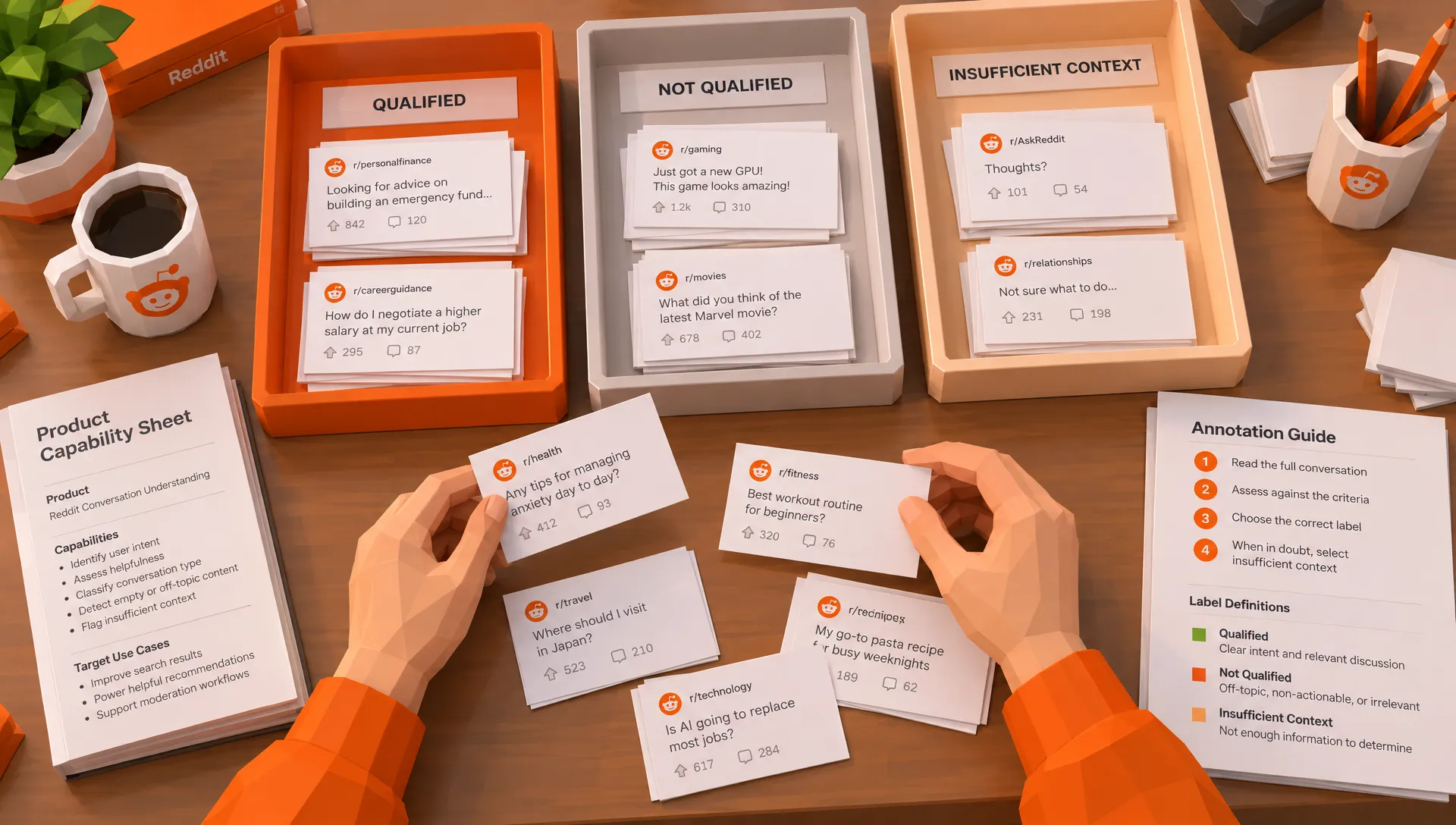
A test dataset for AI Reddit lead detection should answer a practical question: does your detector find conversations worth acting on, or does it mostly recognize familiar keywords? A model can spot “recommend a tool” and still miss the buyer’s actual need, confuse a vendor’s promotion with a purchase request or recommend a product that does not fit.
For Reddit lead generation, a useful benchmark needs realistic conversations, explicit qualification rules and examples the model has never seen during development. This guide explains how to build that benchmark, measure its limits and use it to improve your detector without accidentally inflating its scores.
Define what the detector is supposed to identify
Start with a written definition of a qualified opportunity. “Someone mentioned our category” is too broad to produce consistent labels.
For this guide, a positive example is a conversation in which someone is actively seeking, comparing or planning to adopt a solution that matches the product’s documented capabilities. A relevant topic alone is not enough.
Freeze a short product profile before labeling. Include the problem solved, supported use cases, intended customers and known exclusions. If pricing or integrations affect qualification, record only verified information. Unknown capabilities should remain unknown.
This matters because product fit is relative. A request for enterprise social listening may be a lead for one provider and a poor match for a narrower Reddit monitoring product.
Also choose the unit of evaluation. A useful default is one target post or comment, together with the context available when it was detected. Avoid labeling an entire thread as a lead when only one participant expresses buying intent.
Separate product fit from buying intent
Keep the component labels instead of storing only a yes-or-no verdict. They make disagreements and model failures easier to diagnose.
| Label dimension | Suggested values | What it captures |
|---|---|---|
| Product fit | Yes, no, insufficient information | Whether the stated need matches documented capabilities |
| Buying intent | Active, passive, none, unclear | Whether the author is seeking or evaluating a solution |
| Qualification | Qualified, not qualified, insufficient context | The final decision under your written policy |
| Evidence | Supporting text span | What justifies the decision |
| Exclusion reason | Self-promotion, resolved need, mismatch, other | Why a relevant-looking conversation is not a lead |
For the initial policy, require product fit and active buying intent for a qualified label. Keep insufficient-context cases separate rather than forcing annotators to guess.
A detection label is not permission to post a promotional reply. Whether a conversation contains a lead and whether automated engagement is appropriate are separate decisions. Your dataset should make clear which task it evaluates.
Sample the conversations your detector actually encounters
A benchmark built entirely from obvious recommendation requests will make most detectors look better than they are.
Collect examples across relevant communities, different days, post lengths and conversation types. Include comments as well as submissions if your production system processes both. Preserve the language scope of the intended deployment.
Most importantly, document where sampling begins. If you collect only conversations returned by keyword searches, your benchmark measures classification within those search results. It cannot establish how many opportunities the searches missed.
To evaluate broader discovery, sample from a wider stream of relevant community activity and label it independently of the detector’s predictions. This provides a reference pool in which missed opportunities can be counted.
If your system starts with a retrieval stage, keep that boundary explicit when you automate Reddit monitoring for lead generation. Retrieval coverage and downstream classification quality are different measurements.
Keep representative examples and challenge cases separate
Build two evaluation sets with different purposes:
A naturalistic holdout: Sample from the deployment stream without deliberately changing the positive rate. Use it to estimate operational precision, workload and recall within the sampled scope.
A challenge set: Deliberately collect difficult negatives, subtle positives and ambiguous contexts. Use it to diagnose specific weaknesses, not to estimate everyday lead volume.
An illustrative initial labeling budget might allocate 600 examples to development, 1,000 to a naturalistic test set and 400 to a challenge test set. These are planning numbers, not a statistical minimum. Training data, if needed, sits outside this allocation.
A thousand examples may still contain too few positives for a useful recall estimate when qualified opportunities are rare. Expand the representative sample based on observed positive counts and uncertainty, not a fixed dataset-size target.
Keep synthetic examples in a separately identified diagnostic set. They are useful for testing edge cases but should not replace real held-out conversations in your main performance report.
Include hard negatives that resemble genuine leads
Hard negatives expose whether the model understands intent rather than matching category vocabulary.
The following examples are synthetic. Assume the evaluated product supports monitoring Reddit for sales opportunities; these are not claims about any specific product’s full capabilities.
| Conversation excerpt | Expected label | Reason |
|---|---|---|
| “What are agencies using to find potential customers in Reddit discussions?” | Qualified | Active solution search within the supported use case |
| “We want to replace manual Reddit searches. Any lead-monitoring recommendations?” | Qualified | Explicit replacement intent and a matching need |
| “I built a tool that finds sales leads on Reddit. Try it here.” | Not qualified | Seller promotion rather than buyer demand |
| “We needed Reddit monitoring last year, but our current setup works.” | Not qualified | The need is historical and described as resolved |
| “Can anyone recommend a tool for tracking warehouse inventory?” | Not qualified | Buying language without product fit |
| “Does it support that workflow?” | Insufficient context | The target text does not establish the need or referent |
Also include negation, quoted recommendations, sarcasm and requests for capabilities the product does not offer. Add positive examples that lack obvious buying words, provided they meet your written policy.
For example, “I spend every Friday searching Reddit manually and need to replace that process this month” expresses an active need without asking for “the best tool.”
Preserve the context available at detection time
A standalone comment often cannot be labeled reliably. “Same problem here” means little without its parent, while a title can appear commercially relevant even when the body rules out your product.
Store the target text, submission title, relevant body text and required parent comments. Define a consistent context window so annotators and the model receive the same evidence.
Crucially, exclude future replies. If a person reveals a purchasing need three hours after detection, that information must not appear in the original test input. Otherwise, the benchmark rewards access to information the production system did not have.
The dimensions used to analyze Reddit thread context, such as needs, objections and existing solutions, can help determine which context to retain. Keep only what is necessary for the task and pseudonymize author identifiers where possible.
Use a reproducible example format
A compact JSON record makes the dataset easier to review and score. This synthetic example illustrates the structure:
Keep gold labels and evidence separate from model inputs during evaluation. Accidentally passing an annotator’s explanation to the detector is a direct form of answer leakage.
Store collection details, sampling probabilities where applicable and annotation history alongside these records. A dataset is difficult to reproduce if its selection process exists only in someone’s memory.
Write annotation rules before labeling at scale
Run a small pilot before committing the full labeling budget. Have two annotators independently label the same examples using the product profile and policy.
Require a supporting text span for positive decisions. For negatives, record a reason code. For insufficient-context cases, record what information is missing rather than speculating about the author.
Review disagreements by category. If annotators repeatedly disagree about unresolved complaints, clarify whether a complaint alone qualifies or whether an explicit search for a solution is required.
Track raw agreement and a chance-adjusted measure such as Cohen’s kappa for two annotators. Neither number replaces inspection of disagreements, especially when most examples are negative. Report agreement on positive cases separately so majority-class agreement does not hide a weak qualification policy.
For a larger dataset, double-label a random subset plus difficult cases, then adjudicate disagreements before freezing the test set. Keep the random subset distinct if you use it to estimate overall agreement.
An AI model can assist with draft labels, but its suggestions are not independent ground truth. Reviewers should not simply approve the detector’s own predictions, and the final benchmark should receive human validation.
Split by conversation and time to prevent leakage
Randomly dividing individual comments can place nearly identical context in development and test data. A model may then appear to generalize when it is recognizing a conversation it has already encountered.
Keep every example from the same thread in one partition. Deduplicate exact copies and inspect near-duplicates, including cross-posts, quoted passages and repeated promotional templates.
Use a later time window for the main holdout when your goal is performance on future conversations. Purge thread overlap across the boundary rather than letting an ongoing discussion appear in both development and test sets.
Author grouping can provide an additional stress test when repeated authors contribute distinctive wording. A separate community holdout can test transfer to unfamiliar subreddits. These answer different questions, so report them separately from the main deployment estimate.
Maintain three clear roles: training data changes model weights, development data guides prompts and thresholds, and test data estimates performance after those choices are fixed. Even a detector that uses prompting rather than fine-tuning still needs a development/test boundary.
Measure lead quality, not just overall accuracy
Accuracy can be misleading when most conversations are not leads. A detector that rejects everything may achieve high accuracy while finding no opportunities.
Use metrics that expose both missed leads and unnecessary alerts:
| Metric | Calculation | What it tells you |
|---|---|---|
| Precision | True positives / all predicted positives | How often a detected lead is actually qualified |
| Recall | True positives / all labeled positives | How many qualified opportunities the detector finds |
| F1 score | Harmonic mean of precision and recall | A combined view when both matter |
| Precision at k | Qualified examples among the top k results / k | Quality within a fixed review capacity |
| Alert volume | Predicted positives per sampled period or input count | Expected review or downstream processing workload |
Suppose the detector flags 100 conversations, 80 are qualified and the evaluated pool contains 160 qualified opportunities. Precision is 80%, while recall is 50%. Those figures are illustrative, not performance claims about Redditor AI.
The scikit-learn documentation on precision and recall provides standard definitions for implementing these calculations.
Report evaluation scope and uncertainty
Always state the denominator behind recall. Recall measured only among retrieved candidates is conditional on retrieval. It is not end-to-end recall across the wider conversation stream.
For end-to-end evaluation, count a labeled opportunity as missed if retrieval never surfaced it. Deduplicate the reporting unit so one discussion does not become several apparent leads simply because multiple comments were detected.
Report naturalistic results separately from challenge-set results. If you deliberately oversample certain groups and know their deployment proportions or inclusion probabilities, use appropriate weighting for population estimates. Otherwise, present subgroup results without claiming they describe the live stream.
Include sample counts and confidence intervals. Because comments within a thread are related, uncertainty estimates should respect thread-level clustering rather than assuming every comment is independent. Break down performance by intent type, community and exclusion reason to identify where errors concentrate.
Tune thresholds on development data only
If the detector produces a score, evaluate several thresholds on the development set. Do not assume a score of 0.8 means an 80% probability of qualification unless calibration has been assessed.
Choose the operating point around the actual workflow. A team reviewing a short daily queue may prioritize precision at its review capacity. A discovery workflow with inexpensive human screening may tolerate more false positives to improve recall.
Abstentions also need a policy. If the model can return “insufficient context,” report how often it abstains and where those cases go. Do not silently remove them from evaluation to improve the headline score.
Freeze the prompt, model configuration, product profile and threshold before evaluating the final holdout. If the test results lead you to change those choices, treat that set as exposed and reserve fresh data for the next independent estimate.
Turn errors into a versioned regression suite
Keep a compact suite of adjudicated failures for repeated testing. Useful categories include vendor self-promotion, resolved needs, unsupported feature requests, missing parent context and subtle replacement intent.
This regression suite helps prevent a prompt improvement from fixing one problem while reintroducing another. It is intentionally curated, so it should not replace the representative holdout.
For every evaluation run, save the dataset version, product-profile version, prompt version, model identifier, threshold and raw predictions. Record changes to annotation policy as well as changes to the detector.
Refresh the naturalistic benchmark when the product’s capabilities, target audience or conversation sources change. Preserve older versions for comparison, but do not interpret a changed qualification definition as a pure model improvement.
The benchmark itself is part of the system. A high score is useful only when the underlying labels and sampling still represent the leads your business wants to find.
Frequently asked questions
How many examples do I need to test an AI Reddit lead detector? Enough to contain meaningful numbers of qualified opportunities and common failure types. Start with a pilot to estimate prevalence, then expand based on positive counts and confidence intervals rather than choosing a universal minimum.
Can I use synthetic Reddit conversations? Yes, for controlled edge cases and regression tests. Keep them identified and separate from the real-world holdout used to estimate deployment performance.
Should clicks or conversions determine the gold label? Not for a detection-time qualification task. Conversion depends on later engagement, pricing and other factors. Track it as a downstream outcome rather than using future behavior to rewrite what the detector could know initially.
Can an LLM label the entire test set? It can draft annotations, but unreviewed model labels can reproduce the same errors you are trying to measure. Use independent human review and adjudication for the benchmark.
Evaluate the opportunities behind the automation
Before putting Reddit lead detection on autopilot, define what a worthwhile conversation looks like and measure how reliably your system finds it.
Redditor AI uses AI-driven monitoring to find relevant Reddit conversations and automatically promote your brand, with URL-based setup. A well-built evaluation dataset gives your team a clear standard for assessing whether detected conversations match your product, audience and acquisition goals.

Vincent JOSSE is the Co-Founder of Redditor AI. He's spent the last 1.5 years mastering Reddit as a growth channel, helping brands scale to six figures through strategic community engagement.