

How to Turn Competitor Threads on Reddit Into Pipeline
A practical guide to finding competitor conversations on Reddit, qualifying buyer intent, and turning high-intent threads into measurable pipeline.
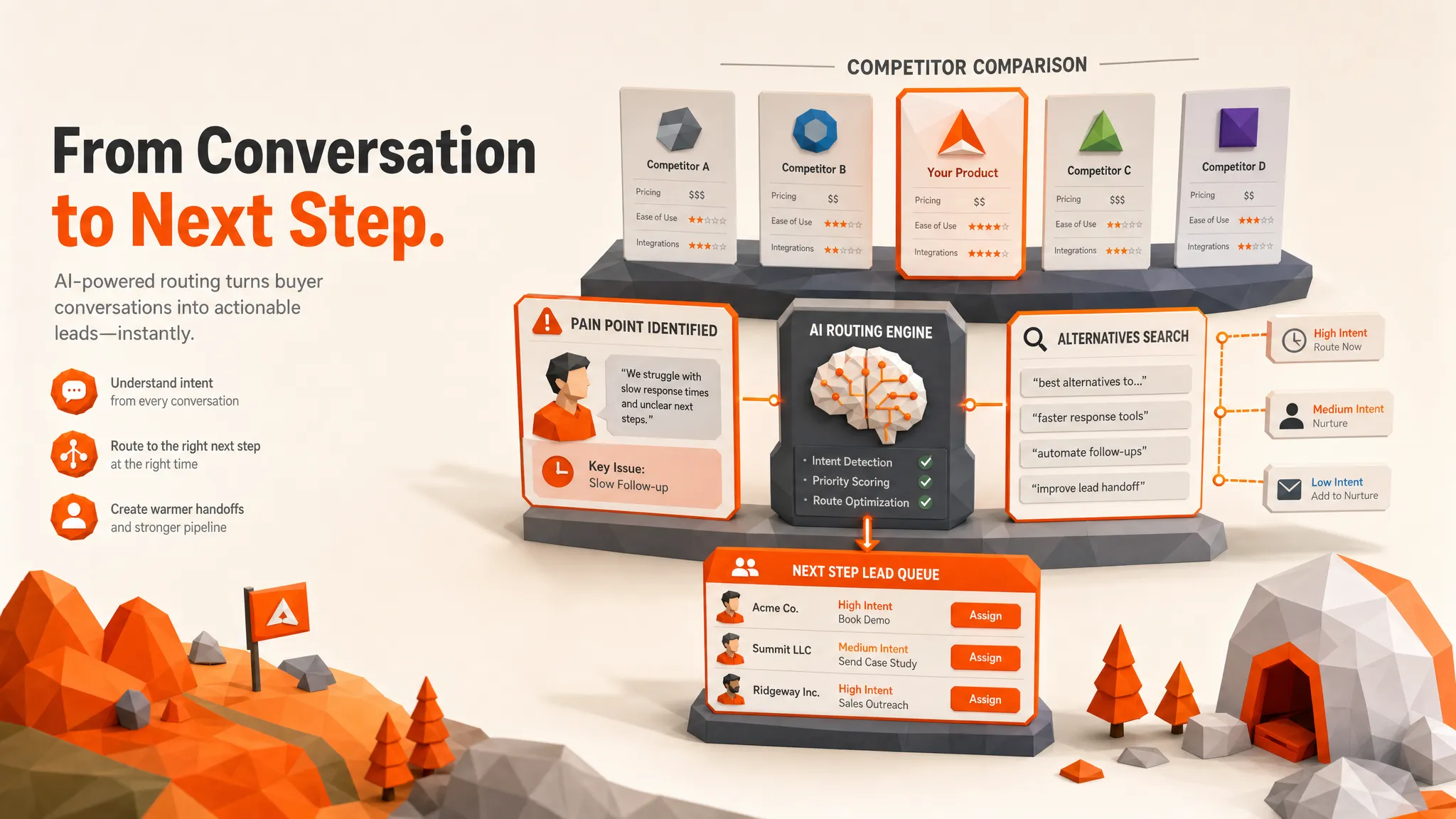
Competitor threads on Reddit are not just social listening alerts. They are public sales conversations where buyers explain what they tried, what broke, what they wish existed, and what they might buy next.
The opportunity is not to “roast” a competitor or drop a link into every mention. The opportunity is to build a repeatable pipeline motion: find the right threads, qualify the buyer intent, answer in a way that earns trust, route interested users to the right next step, and measure which conversations become revenue.
If you already monitor brand mentions, competitor threads are the next level. They reveal demand that is already active, because the person is discussing a known solution, comparing options, or asking whether there is a better fit. Done well, this becomes one of the highest-intent forms of Reddit lead generation.
What counts as a competitor thread?
A competitor thread is any Reddit post or comment where a buyer references another product, service, marketplace, agency, or workaround that solves the same problem you solve.
That includes obvious mentions like “Is [Competitor] worth it?” But the highest-converting threads are often less direct. A user may complain about pricing, ask for alternatives, describe a failed implementation, or compare two vendors without naming your category exactly.
Think in terms of buying moments, not just brand names.
| Competitor thread type | What the user is really signaling | Best pipeline action |
|---|---|---|
| “Is [competitor] worth it?” | Evaluation, risk reduction, comparison shopping | Give a balanced decision framework and soft CTA |
| “[Competitor] alternatives?” | Active replacement search | Map options by use case and introduce your fit if relevant |
| “I hate [competitor] because...” | Pain, churn risk, urgency | Validate the pain, explain tradeoffs, offer a migration path |
| “[Competitor] vs [other tool]” | Shortlist stage | Clarify selection criteria and position your differentiated use case |
| “How do I do X in [competitor]?” | Implementation friction | Solve the immediate issue, then mention a simpler path if true |
| “Why is [competitor] so expensive?” | Budget concern, pricing sensitivity | Explain total cost drivers and offer a lower-friction next step |
| “What tool do you use for X?” | Category demand, open vendor search | Provide a shortlist and explain where your product fits |
The key is that each thread deserves a different response and conversion path. A pricing complaint should not receive the same comment as an alternatives thread. A frustrated customer should not get a generic sales pitch. A buyer comparing vendors wants a helpful decision lens.
Why competitor threads convert better than cold outreach
Most cold outbound starts with a guess. You guess the account has the problem. You guess the contact owns the problem. You guess the timing is right.
A competitor thread removes several of those guesses. The user has already raised their hand publicly. They have named a problem, mentioned an existing solution, and invited opinions from peers. That gives you three advantages.
First, the language is unfiltered. Reddit users often describe pain in sharper terms than they would on a demo call. They say the product is too slow, too expensive, too complex, too limited, or not built for their use case. That language can improve your positioning, landing pages, sales scripts, and objection handling.
Second, timing is visible. A thread posted two hours ago asking for alternatives is much more actionable than a static lead list. Speed matters because early, useful replies tend to shape the conversation before the thread fills with low-effort recommendations.
Third, trust is peer-driven. Reddit users are often skeptical of polished marketing. A clear, specific, useful comment can outperform a sales email because it participates in the buyer’s existing research process rather than interrupting it.
That said, competitor threads only become pipeline when you treat them like a system. Random commenting creates activity. A measured workflow creates opportunities.
Step 1: Build your competitor demand map
Before you search Reddit, document the competitor demand you want to intercept. This keeps your workflow focused and prevents your team from chasing every mention.
Start with five categories of terms:
Direct competitor names, including misspellings, abbreviations, old product names, and founder names if buyers use them.
Category terms, such as “CRM,” “Reddit monitoring tool,” “help desk,” “AI writing tool,” or “customer support software.”
Replacement phrases, such as “alternative to,” “switching from,” “better than,” “moving off,” “canceling,” and “worth it.”
Pain phrases, such as “too expensive,” “hard to use,” “keeps breaking,” “support is bad,” “missing feature,” and “overkill.”
Purchase phrases, such as “recommend,” “best tool,” “what should I use,” “looking for,” “anyone tried,” and “need something for.”
This demand map should also include your best-fit and poor-fit segments. For example, if your product is built for small SaaS teams, a thread from an enterprise procurement subreddit may be interesting but not urgent. If you sell to agencies, a thread from an agency operations subreddit may deserve a faster response than a broad technology thread.
A useful competitor demand map answers one question: “Which competitor-related conversations are likely to become qualified pipeline if we respond well?”
If you need a broader foundation for query building, the Redditor AI guide on building a Reddit keyword pack that finds buyers pairs well with this step.
Step 2: Search for buying events, not just names
Searching only for competitor names creates a noisy feed. You will find product updates, memes, support complaints, employee chatter, and old threads that no longer matter.
Instead, combine competitor terms with intent modifiers. The goal is to find buying events.
Here are practical query patterns:
| Query pattern | Example | Why it works |
|---|---|---|
| Competitor + alternatives | “CompetitorName alternative” | Captures active replacement demand |
| Competitor + worth it | “CompetitorName worth it” | Finds evaluation-stage buyers |
| Competitor + vs | “CompetitorName vs OtherTool” | Finds shortlist-stage comparisons |
| Competitor + pricing pain | “CompetitorName expensive” | Finds budget objections and churn risk |
| Competitor + implementation pain | “CompetitorName hard to set up” | Finds users blocked by complexity |
| Category + recommendation | “best tool for [job]” | Finds open demand before a competitor is chosen |
| Competitor + missing feature | “CompetitorName doesn’t support” | Finds feature-gap opportunities |
You should also search inside specific subreddits where your buyers already compare tools. Broad Reddit search is useful, but subreddit-level monitoring often produces higher fit. A niche subreddit with 20 comments from your ICP can be more valuable than a viral thread full of casual opinions.
This is where AI social media automation becomes useful. Instead of manually checking dozens of queries each day, an AI-driven monitoring system can scan Reddit conversations continuously, classify intent, and surface the threads that deserve action.
Step 3: Score competitor threads before replying
Not every competitor mention deserves a response. Some threads are too old. Some are not relevant. Some users are venting with no buying intent. Some conversations have high visibility but no conversion path.
Use a simple scoring model to decide what becomes a pipeline opportunity.
| Signal | Low score | High score |
|---|---|---|
| Intent | Casual mention or joke | Asking for recommendations, alternatives, pricing, or migration help |
| Fit | User is outside your target market | User matches your ICP, role, company size, use case, or region |
| Timing | Thread is old or inactive | Thread is fresh, active, or recently revived |
| Pain clarity | Complaint is vague | Pain is specific and tied to cost, time, risk, or lost revenue |
| Competitor gap | No clear opening | Your product has a relevant and provable advantage |
| Conversion path | No logical next step | You can offer a guide, comparison, demo, trial, or waitlist |
For a fast operating model, classify threads as P1, P2, or P3.
| Priority | Definition | Response target | Example |
|---|---|---|---|
| P1 | Fresh thread, clear buying intent, strong fit, obvious next step | Same day, ideally within 1 to 2 hours | “Looking for a [competitor] alternative for my SaaS team” |
| P2 | Relevant thread with moderate intent or unclear fit | Within 24 hours | “Is [competitor] still good in 2026?” |
| P3 | Low intent, old, broad, or mainly research value | Save for insight, respond only if useful | “Random thoughts on tools in this category” |
This prevents your team from wasting time on low-value threads while missing the few conversations that could become real opportunities. For a deeper prioritization system, see the Redditor AI guide to thread triage for Reddit leads.
Step 4: Reply like a helpful buyer, not a competitor
The best competitor-thread replies do not sound like ads. They sound like someone who understands the tradeoffs and can help the buyer make a better decision.
A strong reply usually has five parts:
Mirror the user’s situation in one sentence.
Answer the actual question before mentioning your product.
Explain the tradeoff that matters in this decision.
Offer proof, examples, or a practical checklist.
Use a low-pressure CTA that matches the thread’s intent.
Here is a simple structure you can adapt:
If your main issue with [competitor] is [specific pain], I’d separate the decision into three buckets: [criterion 1], [criterion 2], and [criterion 3]. [Competitor] is usually strong when [fair advantage], but it can be frustrating when [limitation]. If you need [your strongest use case], you may want to compare it with tools built specifically for that. I work on [your product], so I’m biased, but here’s the quick fit: it’s best for [specific ICP/use case], not ideal for [poor-fit case]. Happy to share a checklist or link if useful.
Notice what this does. It does not attack the competitor. It does not claim to be best for everyone. It gives the reader a decision framework, shows useful context, and creates a natural opening for a next step.
A bad reply says, “Use us instead.” A good reply says, “Here is how to make the decision. If your situation matches this specific use case, we may be worth a look.”
If you want more comment patterns, the guide on Reddit reply templates that convert without sounding salesy gives reusable structures you can adapt to competitor threads.
Step 5: Match the CTA to the buyer’s stage
A common mistake is sending every Reddit user to the same homepage or demo form. Competitor threads are more nuanced. Someone asking “Is this tool worth it?” may want a comparison. Someone saying “I need to switch this week” may be ready for a call. Someone complaining about one feature may just need a short guide.
Use a CTA ladder instead of one default CTA.
| Thread intent | CTA that feels natural | Conversion asset |
|---|---|---|
| Early comparison | “I can share the checklist I use to compare these.” | Comparison guide or comment follow-up |
| Alternatives search | “Here’s a quick breakdown of when each option fits.” | Alternatives page or short buyer guide |
| Implementation pain | “If helpful, here’s how we solve that workflow.” | Use-case page or product walkthrough |
| Pricing frustration | “This page explains the cost tradeoffs.” | Pricing explainer or ROI page |
| Urgent migration | “Happy to help you sanity-check the switch.” | Demo booking, migration page, or qualification form |
| Waitlist interest | “You can join here if you want early access.” | Waitlist page |
The CTA should feel like the next logical step in the conversation, not a forced handoff to sales.
For example, if the thread is about switching away from a competitor because setup is too complex, a homepage link is weak. A better destination is a thread-matched page that explains how your setup works, what data is needed, how long onboarding takes, and who it is best for.
That is why landing pages matter. Reddit traffic is skeptical and context-rich. If the page ignores the conversation that produced the click, users bounce. If the page mirrors the thread’s pain and answers the obvious objections, the click has a much better chance of becoming pipeline. The Redditor AI article on landing pages for Reddit traffic covers this in more detail.
Step 6: Build competitor-specific bridge pages
A bridge page is a lightweight destination between a Reddit comment and a conversion action. It should help the user continue their evaluation without feeling like they landed on a generic ad page.
For competitor threads, the most useful bridge pages are often:
An alternatives page for users actively replacing a competitor.
A comparison page for users evaluating two or more tools.
A migration page for users worried about switching cost.
A use-case page for users with a specific workflow pain.
A proof page with case studies, examples, testimonials, or measurable outcomes.
You do not need dozens of pages to start. Build one strong page for your most common competitor-related objection. Then add more pages as you see repeated thread patterns.
A good competitor bridge page should answer four questions quickly:
“Am I in the right place based on the Reddit thread I came from?”
“What does this product do differently?”
“What are the tradeoffs or limitations?”
“What is the easiest next step if I want to evaluate it?”
Be careful with comparison claims. If you say your product is faster, cheaper, easier, or more accurate, back it up or phrase it as a fit-based distinction. Specificity beats bravado.
For example, “Built for small teams that want Reddit monitoring and AI-driven engagement without manually checking threads all day” is stronger than “The best Reddit marketing tool.”
Step 7: Capture thread-level attribution
Competitor-thread marketing becomes serious when you can answer: “Which Reddit conversations influenced pipeline?”
At minimum, use UTMs on links you place in comments, DMs, profile links, and bridge pages. Keep the naming simple enough that your team will actually use it.
A practical UTM convention might look like this:
| Parameter | Example | Purpose |
|---|---|---|
| utm_source | Identifies Reddit traffic | |
| utm_medium | organic_comment | Separates comments from posts, DMs, and profile clicks |
| utm_campaign | competitor_threads | Groups the motion |
| utm_content | competitorname_alternative_p1 | Captures thread type and priority |
| utm_term | subreddit_name | Captures the community source |
You should also maintain a thread ledger. This can be a spreadsheet, CRM object, or internal table. The point is to connect each handled thread to outcomes.
Track these fields:
| Field | Why it matters |
|---|---|
| Thread URL | Creates a permanent source record |
| Subreddit | Shows which communities produce qualified demand |
| Competitor mentioned | Reveals where displacement opportunities come from |
| Thread type | Separates alternatives, pricing, complaints, comparisons, and support pain |
| Priority | Helps compare P1 vs P2 vs P3 performance |
| Response time | Shows whether speed affects clicks and conversions |
| CTA used | Helps identify which next steps work |
| Clicks | Measures comment-to-site movement |
| Leads or signups | Measures conversion quality |
| Pipeline or revenue | Ties Reddit activity to business outcomes |
If you want a more complete measurement setup, read the Redditor AI guide to Reddit lead attribution from thread to sale.
Step 8: Turn competitor threads into sales enablement
The value of competitor threads is bigger than the first reply. Each thread can improve your sales and marketing system.
Look for repeated patterns:
Which competitor complaints appear most often?
Which objections stop users from switching?
Which use cases make people ask for alternatives?
Which words do buyers use when describing urgency?
Which proof points earn replies or clicks?
Which competitor advantages do users genuinely value?
These insights should feed four assets.
First, update your battlecards. If Reddit users keep saying a competitor is strong for enterprise teams but painful for solo founders, that should shape how sales positions your product.
Second, improve your comparison pages. Real buyer language from Reddit is often more persuasive than internally invented messaging.
Third, refine your product roadmap. If the same feature gap appears in multiple competitor threads, that may indicate a market opening.
Fourth, create better reply components. A good answer to a recurring competitor objection should become a reusable block, not a one-off comment buried in a thread.
This is how competitor-thread work compounds. The first week may produce a few replies. The fourth week should produce a better objection library, cleaner positioning, more relevant landing pages, and a measurable lead queue.
Step 9: Create a weekly competitor-thread operating rhythm
A pipeline motion needs cadence. Otherwise, competitor monitoring becomes another tab nobody checks.
Here is a simple weekly rhythm for a small growth team.
| Cadence | Activity | Owner |
|---|---|---|
| Daily | Review new P1 and P2 competitor threads | Growth or founder |
| Daily | Reply to qualified threads and log outcomes | Growth, sales, or community owner |
| Twice weekly | Review clicks, replies, and conversions | Growth lead |
| Weekly | Update query pack and exclusion filters | Marketing ops |
| Weekly | Add new objections to battlecards and reply library | Sales and marketing |
| Monthly | Identify top-performing subreddits, competitors, and CTAs | Growth lead |
The goal is not to maximize comment volume. The goal is to improve pipeline quality per handled thread.
A team that handles 15 high-fit competitor threads per week with strong replies, good destinations, and clean attribution will usually learn more than a team that blasts 200 generic comments.
Step 10: Use AI to scale the parts humans are bad at
Humans are good at judgment, nuance, and relationship-building. Humans are not good at checking Reddit all day, remembering every competitor alias, scoring hundreds of threads consistently, and logging outcomes forever.
That is where an AI powered workflow helps.
For competitor-thread pipeline, AI is most valuable for:
Monitoring Reddit conversations across competitor, category, and pain keywords.
Detecting thread intent beyond exact-match keywords.
Prioritizing threads by fit, urgency, and conversion potential.
Drafting context-aware replies that a human can approve or refine.
Routing opportunities into a daily queue.
Tracking which conversations lead to clicks, signups, demos, or customers.
Redditor AI is built around this kind of workflow. It uses AI-driven Reddit monitoring to find relevant conversations and can automatically promote your brand in context, helping turn Reddit conversations into customers. Its URL-based setup also reduces the time needed to define your product positioning before monitoring begins.
The best use of automation is not to remove strategy. It is to make sure you never miss the right thread, respond while the conversation is still active, and keep learning from every outcome.
Example workflow: from competitor thread to pipeline
Here is what the full motion looks like in practice.
A user posts: “Has anyone switched away from [competitor]? We’re using it for lead monitoring, but it misses too many relevant conversations and takes too much manual work.”
The workflow:
| Stage | Action |
|---|---|
| Detection | Monitoring flags the competitor name plus “switched away” and “misses relevant conversations.” |
| Qualification | Thread is marked P1 because it is fresh, specific, high-intent, and aligned with your product. |
| Reply | You acknowledge the issue, explain what to check in any replacement tool, and mention your product only if it fits. |
| CTA | You link to a comparison or use-case page about automated conversation monitoring. |
| Capture | UTM parameters identify the source thread, competitor, subreddit, and CTA. |
| Conversion | User clicks, joins a waitlist, signs up, or books a call. |
| Follow-up | Sales references the exact pain from the thread and continues the conversation with context. |
| Learning | The thread is logged as a “missed relevant conversations” objection and added to your reply library. |
This is pipeline, not just engagement. The comment is only one step in a measured acquisition loop.
Common mistakes that kill competitor-thread pipeline
The biggest mistake is replying too aggressively. If your comment reads like an attack ad, users will ignore it or push back. Balanced comments convert better because they feel credible.
The second mistake is linking too early. If the comment has no standalone value, the link feels like the point of the reply. Give the reader something useful before asking for a click.
The third mistake is treating every competitor complaint as a fit. Sometimes the user wants a feature you do not offer, a price point you cannot support, or a workflow outside your focus. Saying “we are probably not the best fit” can build more trust than forcing a pitch.
The fourth mistake is failing to route clicks to relevant destinations. Competitor-thread traffic is high-context. A generic homepage often wastes that context.
The fifth mistake is not tracking outcomes. Without UTMs, a thread ledger, and CRM notes, Reddit will look like “brand activity” instead of pipeline contribution.
A 7-day plan to launch competitor-thread pipeline
You can start small and still make the motion measurable within a week.
| Day | Focus | Deliverable |
|---|---|---|
| Day 1 | Competitor demand map | List competitors, aliases, pain terms, replacement phrases, and target subreddits |
| Day 2 | Query pack | Build 20 to 40 searches around alternatives, comparisons, pricing, migration, and feature gaps |
| Day 3 | Triage rubric | Define P1, P2, P3 criteria and response targets |
| Day 4 | Reply components | Draft reusable blocks for alternatives, pricing pain, migration, and comparison threads |
| Day 5 | Conversion assets | Create one competitor bridge page or one thread-matched landing page |
| Day 6 | Attribution | Set UTM rules and create a thread ledger |
| Day 7 | Review and iterate | Analyze handled threads, clicks, replies, objections, and next experiments |
After the first week, the most important improvement is usually focus. Remove noisy queries. Double down on subreddits with real buyer language. Rewrite replies that sound too generic. Build landing pages for the objections that appear repeatedly.
Frequently Asked Questions
What is the difference between competitor mentions and competitor threads? A competitor mention is any reference to a competitor. A competitor thread is a conversation where that mention creates a potential buying event, such as an alternatives search, pricing complaint, comparison, migration question, or implementation problem.
How fast should we respond to competitor threads on Reddit? For high-intent P1 threads, aim to respond the same day, ideally within the first few hours while the discussion is still forming. For P2 threads, a useful reply within 24 hours can still perform well if the conversation is active.
Should we name our product directly in competitor threads? Yes, when it is relevant and the comment provides value first. The safest pattern is to answer the user’s question, explain your fit and limitations clearly, then offer a low-pressure next step.
What should we track to prove competitor threads create pipeline? Track thread URL, subreddit, competitor mentioned, thread type, priority, response time, CTA, UTM-tagged clicks, signups, demos, pipeline, and revenue. Without thread-level attribution, the channel is hard to evaluate.
Can AI handle competitor-thread monitoring automatically? AI is well-suited for monitoring, intent detection, prioritization, drafting, and routing. Human judgment is still valuable for high-stakes replies, nuanced comparisons, and sales follow-up.
Turn competitor conversations into customers
Competitor threads are already happening with or without you. Buyers are asking which tools to choose, which products to replace, and which vendors are worth trusting.
The teams that win are not the loudest. They are the fastest to find relevant Reddit conversations, the clearest in their answers, and the most disciplined about turning replies into measurable pipeline.
Redditor AI helps you find relevant Reddit conversations on autopilot and automatically promote your brand with AI, so competitor-thread monitoring becomes a repeatable customer acquisition workflow instead of a manual search habit.
If Reddit is part of your growth strategy in 2026, start with your competitor threads. They are where active demand is already telling you what it wants next.

Vincent JOSSE is the Co-Founder of Redditor AI. He's spent the last 1.5 years mastering Reddit as a growth channel, helping brands scale to six figures through strategic community engagement.